📬🧭How to inform about fertility, identify difficulties and guide without delay? This report provides field actors with benchmarks to support the public, an infertility assessment sheet and suggestions to make pathways more accessible, coordinated and attentive to everyone's needs

. This report helps field actors to better inform the public about fertility, to identify situations requiring consultation and to facilitate referral to competent professionals. The ‘Infertility Assessment’ sheet in the appendix specifies the timelines for care and the warning signs justifying early referral; the letter intended for people aged 29 provides support for addressing reproductive health without pressure to parenthood. The report also offers suggestions for improving support: psychological support, tailored information, consideration of vulnerabilities and cooperation with associations and partner patients. It finally allows for distinguishing resources that can be mobilised immediately from proposed developments, which remain to be instructed or implemented
Source :
1️⃣ SUMMARY
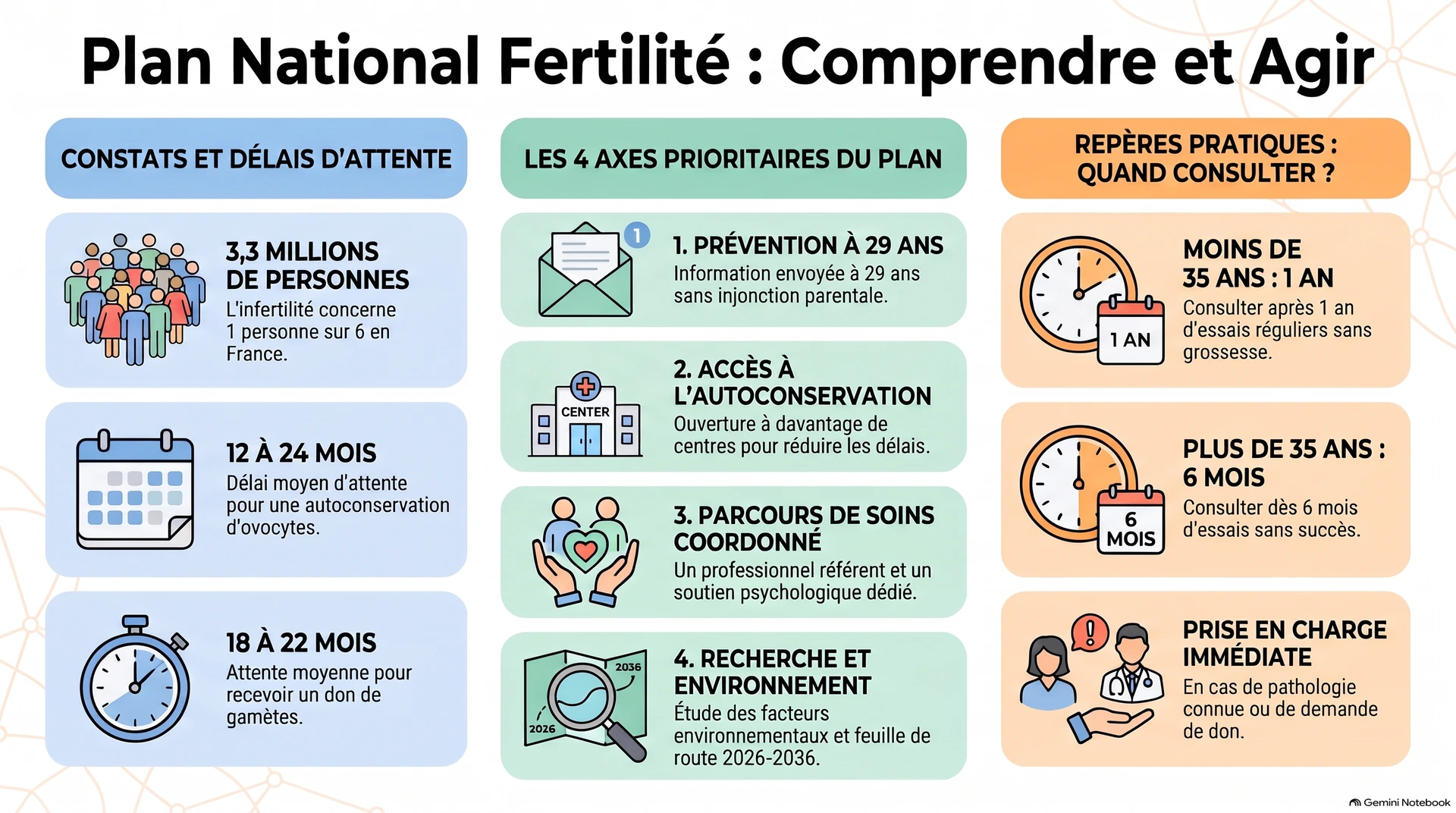
Theinfertility, which affects 3.3 million people according to the report, is a major public health issue. Presented on 5 February 2026, the fertility plan includes four axes and sixteen measures, which the national steering committee supports in its implementation. The report makes 36 recommendations to strengthen prevention, improve access to care and support research. It advocates for accessible information on reproductive health, notably through a letter addressed to individuals aged 29, as well as the development of preconception consultations and early identification of difficulties. In light of waiting times, it proposes to open ovocyte self-preservation to all public and private ART centres, with appropriate resources and enhanced territorial organisation. This evolution should be accompanied by rigorous information on the limits and risks of the technique. The COPIL also proposes to examine additional financial participation for self-preservation without medical indication.
For the donation of gametes and the reception of embryos, the report recommends a better-coordinated national organisation, a shared information system and secure circulation of stocks between centres. It proposes to open donation to voluntary public and private centres, upon national specifications and ethical guarantees. The care pathway should be simplified through an identified coordinator, monitoring of timelines and better coordination between city professionals and specialised centres. Psychological support, adaptation to vulnerabilities and the participation of partner patients are also valued. The report integrates lifestyles and environmental exposures and proposes a research roadmap for 2026-2036. It specifically requests to instruct the authorisation of the preimplantation diagnosis of embryonic aneuploidies. Eleven recommendations require prior instruction; six annexes complete the text, including public correspondence and an infertility summary sheet.
2️⃣ WHAT TO REMEMBER
1️⃣ Observation: long delays. In 2025, 6,720 women underwent at least one retrieval for a non-medical self-preservation, an increase of +31% compared to 2024; average delay of 11.7 months, from 14 to 24 months in Île-de-France (p. 20). Average delay for ART with donation: approximately 18 months for sperm, approximately 22 months for oocytes (p. 10).
2️⃣ Recommendation: broaden the offer. The COPIL recommends a single authorisation for all public and private ART centres to participate in oocyte self-preservation (recommendation 2, p. 21), and the opening of donation to voluntary public and private centres, under national specifications (recommendation 8, p. 27). These are recommendations, not decisions.
3️⃣ Recommendation: rethink the pathway. The COPIL proposes to identify a professional responsible for the coordination of the pathway in each centre (recommendation 27, p. 40), to offer psychological support from the entry into the pathway (recommendation 30, p. 43) and to establish a national monitoring of timelines (recommendation 28, p. 42). It also recommends complementing the usual indicators with measures of care outcomes reported by patients, the PROMs, and their experience of care, the PREMs, as well as qualitative feedback processes (p. 45-46).
Empowerment, participation and community health : the report proposes to involve partner patients and associations in the design of information materials, in the evaluation of the experience, in identifying pathway disruptions and in reflecting on the organisation of centres (p. 46). It also advocates for peer groups and spaces for exchanges between concerned individuals (p. 31 and 46). The letter at 29 years is presented as a means to strengthen the empowerment of young adults, “without injunction or social pressure” (p. 17). These proposals support the participation of concerned individuals, without constituting a structured community strategy.
3️⃣ TO ACT
1️⃣ Identify and direct without delay — a tool proposed in the report. The sheet from annex 2 reminds that care must be initiated after one year of unprotected regular intercourse, after six months if the woman is over 35 years old, and earlier in cases of obvious cycle disorders or known or suspected genital pathology (p. 55). It also specifies the warning signs justifying immediate referral to a specialised centre (p. 56). Developed by the COPIL to guide the primary care professionals, this sheet complements the recommendations of the HAS and learned societies, of which recommendation 24 calls for wide dissemination (p. 39-40).
2️⃣ Anticipate questions related to the letter for 29-year-olds — preparation for an action that the document announces. The sending of a letter/email from the Health Insurance to all 29-year-olds is "at this stage experimental" (p. 16). Its text refers to www.sante.fr, to preconception consultations and to a page on infertility from Santé.fr (annex 1, p. 53-54).
Suggestion Health Practices : rely on the space "My fertility" of Santé.fr to answer the questions of the public and the teams. This portal offers information on the factors influencing fertility, the child project, medical assistance for procreation and misconceptions, as well as videos and an Info Fertility quiz. The frequency figures must be presented with their original wording: the report indicates that infertility concerns one in six people during their reproductive life (p. 37), while Santé.fr mentions nearly one in four couples experiencing difficulties in conceiving, referring to the 2022 report. These indicators are not directly comparable, as they neither refer to the same unit nor to an identical wording of the phenomenon. Separately, an AFP dispatch published by Vidal on 3 November 2026 announces the sending of a message on the portal of the Health Insurance to people aged 29 by the end of November 2026: this timing detail comes from an external source to the report.
3️⃣ Inform about self-preservation without presenting it as a guarantee — action explicitly requested by the document. The COPIL recommends informing women that oocyte self-preservation does not guarantee pregnancy, that the chances depend particularly on the number of preserved oocytes and the age at freezing, and that it is a medical act with identified risks (p. 18). A homogeneous national information framework still needs to be developed (recommendation 1, p. 19).
4️⃣ 3 PRACTICAL QUESTIONS
1️⃣ When to advise consulting if a pregnancy does not occur? In the absence of any particular problem: after 1 year of attempts before 35 years, after 6 months after 35 years (p. 54). A quicker intervention may be proposed in cases of known or suspected cycle issues or genital pathology (p. 55). For women requiring a sperm donation (female couple or unmarried woman), the document states that immediate intervention is necessary (p. 55).
2️⃣ Who can self-preserve their gametes without medical indication, and where? Self-preservation is possible from the age of 29 up to the 37th birthday for oocytes, and from the age of 29 up to the 45th birthday for spermatozoa (p. 19 and 54). For their subsequent use, the Agency for Biomedicine specifies the following limits: up to the 45th birthday of the woman for her oocytes, also subject to the age of the partner, and up to the 60th birthday of the man for his spermatozoa. According to the framework described in the report, self-preservation without medical indication is reserved for public establishments and non-profit private establishments, with a possible exemption for for-profit private establishments in case of shortage in a department (p. 19). The list of authorised centres is available on the procreation-medicale.fr website.
3️⃣ How long do we wait for ART with donation? For sperm donation, the average waiting time is estimated at 18 months, ranging from 8 to 28 months depending on the centres; for oocyte donation, approximately 22 months (p. 10). The COPIL sets a target waiting time of 6 months, which remains a goal (p. 24).
5️⃣ TO GO FURTHER
Health Practices Blog:
Sexual and reproductive health — Part 1. Fertility and overall health — Part 2. Infertility: first-line exploration - https://pratiquesensante.odoo.com/blog/pratiques-15/sante-sexuelle-et-reproductive-volet-1-fertilite-et-sante-globale-volet-2-infertilite-exploration-en-premiere-intention-6074 and other articles on sexual health - https://pratiquesensante.odoo.com/blog/tag/sante-sexuelle-203
6️⃣ #️⃣ HASHTAGS
#healthpractices #Fertility #Infertility #ReproductiveHealth #ART #OocyteCryopreservation #GameteDonation #CarePathways
🔎 Need to delve deeper into a topic?
The articles from Health Practices provide an initial insight into publications and resources useful for professionals and field actors.
To go further, answer a specific question or explore a topic in depth, I also offer documentary research and personalised monitoring, tailored to your needs and projects. Feel free to contact me: pratiquesensante@pm.me - To find out more
To go further, order a research or documentary monitoring
This article: An editorial production based on
experience enhanced by artificial intelligence - The English version of the site is a machine translation: the French version prevails - Click on the image