
🚨🚨Generative AI: the ethical survival kit that every professional should have read
🔍💡 Generative AI at work: three documents to move from shock to decision — ethical framework, questions to ask, field feedback. A compass, not a prohibition.
🧠⚖️ Bias, data protection, maintaining human judgement: the concrete guidelines for integrating AI without delegating responsibility.
Article echoing the article from Health Practices - White Paper: Educating about AI from school: an emergency plan - Version 1
📌 This corpus provides what is most lacking when generative AI arrives in a service: a shareable decision-making framework, not prohibitions. It offers a three-stage framework (before/during/after), a series of concrete ethical questions (bias, sobriety, transparency, agency) and feedback from practitioners who have tested, failed and adjusted. It can be used from tomorrow to build a team charter, frame a request, or decide when not to resort to AI. The transposition to prevention, social and medico-social is direct: the same issues of literacy, equity, sensitive data and maintaining professional judgement.
Source:📒 The pedagogical, ethical and legal use of generative artificial intelligence. Guide for teaching staff
✍️ Quebec, Ministry of Education - July 2026📜🔗LIEN vers la source
The 3 documents downloadable from the link above :
- Document 1 — The pedagogical, ethical and legal use of generative artificial intelligence. Guide intended for teaching staff. Quebec, Ministry of Education (with Obvia and GRIIPTIC), 2026.
- Document 2 — The pedagogical, ethical and legal use of generative artificial intelligence. Complementary tool intended for teaching staff. Quebec, Ministry of Education, 2026.
- Document 3 — Assessing in the age of AI. Summary deliverable from the practice community « Connected to AI! ». Connected School (Canada) and COP (Belgium), Special digital file, winter 2025‑2026. 59 p. Edition: Audrey Miller. Design and writing: S. Chapelle, C. Colas, J. Delescolle, M. Delmoitiez, L. Di Pasquale, S. Housni, P. Marchal, L. Meirlaen, M. Petrosian, J. Ponsard.
1️⃣ ANALYTICAL SUMMARY
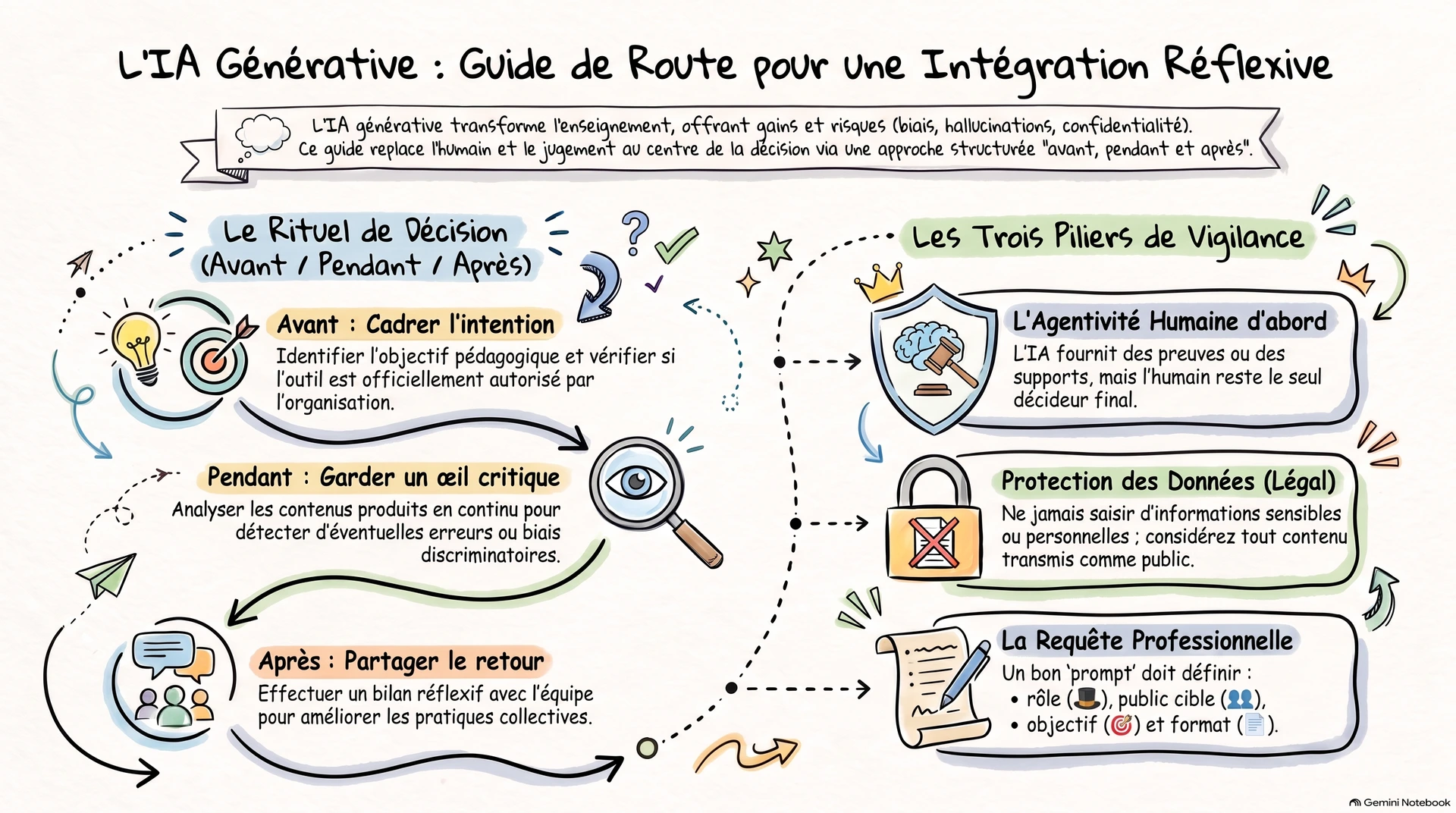
Context and issues — A fast technology facing practices to secure. Generative AI transforms professional practices faster than regulatory frameworks can adapt. The corpus is aimed at teaching staff but targets all practitioners working with audiences, often minors or vulnerable individuals. It identifies a dual tension: on one side, real gains (differentiation, material preparation, feedback, time savings); on the other, documented risks — confabulations (“hallucinations”), biases against already discriminated groups, breaches of confidentiality, cognitive dependency, and erosion of professional agency. The common thread across the three documents is to place the human and professional judgment at the centre of all decision-making.
Operational contributions — From principle to deployable tool. The guide structures the reflection around three criteria (pedagogical, ethical, legal) and provides, at each stage, questions to consider. The complementary tool condenses these questions onto a single page, immediately usable in team meetings. The practical deliverable provides the practical layer: techniques for formulating requests, a "launch pad" from passive use to active use, a method for constructing a charter, and a distinction between myths/reality regarding feedback. Together, they allow for a shift from a posture of avoidance or fascination to a reflective and framed integration.
2️⃣ KEY POINTS OF THE DOCUMENT
1️⃣ The three-phase reflection (before / during / after) is the methodological core of the guide: identifying the objective and verifying that the tool is authorised, critically analysing the content produced during use, and then providing a shared reflective feedback in the team-school (Doc 1, p. 5‑8). It is a framework transferable to any service.
2️⃣ Five operationalised ethical principles — digital sobriety, quality, equity and inclusion, transparency and explainability, agency — each accompanied by concrete questions (Doc 1, p. 11‑17). Notably: smaller models have a lower ecological footprint (p. 11); quality is never guaranteed and must be validated (p. 12).
3️⃣ Three structuring legal obligations : information security, personal data protection, copyright (Doc 1, p. 18‑20). Never enter sensitive, confidential, or personal information without permission; the information transmitted should be considered public by default (p. 18).
4️⃣ Six tested query techniques in a community of practice : zero‑shot, one‑shot, few‑shot, role prompting, reverse prompting, chain of thought (Doc 3, p. 19‑22), with the observation that without framing, AI remains superficial and that free versions impose step-by-step validation (p. 18, 23).
5️⃣ The ‘launch pad’ of usage — demonstration by the teacher, collective co-piloting, guided exploration, then autonomy (Doc 3, p. 26) — coupled with three pillars of evaluation (diagnostic, advanced error analysis, intelligent tutor, p. 27) and a constant reminder: AI provides evidence, the human remains the sole final decision-maker of the grade (p. 28, 50).
3️⃣ ACTION PATHS FOR LOCAL ACTORS
1️⃣ Establish a decision ritual ‘before/during/after’ before any use of AI on a file or action: targeted objective, authorised tool, critical validation, shared feedback (rely on the framework Doc 1, p. 5‑8).
2️⃣ Co‑construct a team/institution charter by following the proposed steps: identify uses, define opportunities and risks, co‑construct with all stakeholders, anticipate exceptions and adjustments, communicate and train (Doc 3, p. 12). Systematically report the use of AI; never hide it (p. 11).
3️⃣ Professionalise the formulation of queries by imposing a minimal template: role, level/audience, objective, format, adaptations for inclusion, request for feedback (Doc 3, p. 18). Reuse the six techniques (p. 19‑22) as a team repertoire.
4️⃣ Protect data by default : no sensitive, confidential or personal data in an AI system without validation from the data security/protection officer; vigilance regarding the risk of indirect re-identification (Doc 1, p. 18‑19; Doc 3, p. 25, 32). Respect the minimum ages of platforms (often 13 or 18 years).
5️⃣ Use AI as an error revealer, not as an autonomous corrector : first assisted pass then human verification, analysis of the faulty cognitive process rather than just true/false (Doc 3, p. 27, 32, 50). Keep the note as an act of professional judgment.
6️⃣ Treat sobriety and agency as selection criteria : favour smaller models, limit the number of requests, and consciously select the tasks where assistance is desired without delegating what underpins competence (Doc 1, p. 11, 15). Unmet need: the corpus remains discreet on the concrete modalities for designating a local AI referent — to be formalised internally.
4️⃣ ADDITIONAL REFERENCES
🔍➕ For more information, see the articles referenced by "Health Practices" on the digital theme ➡️🔗 https://pratiquesensante.odoo.com/blog/tag/numerique-77
and White Paper: Educating about AI from school: an emergency plan - Version 1
Externally
- UNESCO — Guidelines for generative artificial intelligence in education and research (2024). Humanistic and human-centred framework, cited by the guide itself. 👉 https://www.unesco.org/fr/articles/orientations-pour-lintelligence-artificielle-generative-dans-leducation-et-la-recherche
- CNIL — Two FAQs on the use of AI systems in schools (June 2025). French regulatory lever (GDPR), a FAQ for "teachers" and a FAQ for "data controllers". 👉 https://www.cnil.fr/fr/deux-faq-utilisation-des-systemes-dia-scolaire
- High Authority of Health — Supporting the proper use of AI systems in care contexts (framing note, 2025). Direct transposition of issues to the health and medico-social field. 👉 https://www.has-sante.fr/upload/docs/application/pdf/2025-04/note_de_cadrage_-_ia_en_contexte_de_soins_accompagner_les_usages.pdf
5️⃣ FREQUENTLY ASKED QUESTIONS (FAQ)
1️⃣ Should AI be allowed or banned? Neither by principle: the corpus goes beyond prohibition to set clear and fair markers. The decision is made as a team, according to the uses permitted by the organisation (Doc 1, p. 5‑6; Doc 3, p. 10‑11).
2️⃣ How can we know if generated content is reliable? It is never reliable by default: treat every result as a support for reflection, not as an end goal, and validate it critically. Systems produce confabulations presented as facts (Doc 1, p. 12).
3️⃣ Can we input user/student data into AI? No, unless explicitly authorised: sensitive, confidential or personal information is excluded by default, with caution regarding indirect re-identification (Doc 1, p. 18‑19).
4️⃣ How can we obtain a useful response from an AI system? By framing the request: role, level, objective, format, inclusion needs, request for feedback. Without a framework, the response remains superficial (Doc 3, p. 18‑22).
5️⃣ Can AI correct for me? It can assist (first pass, feedback), but never replaces professional judgment; the grade remains a human decision (Doc 1, p. 8; Doc 3, p. 28, 50).
6️⃣ How to address biases with the public? By taking a critical look at the representativeness of minority groups and the presence of biases, even if it means reformulating the request or making it a teaching opportunity (Doc 1, p. 13).
7️⃣ What does "preserving one's agency" mean? Keeping control of one's decisions and avoiding technological dependence by consciously choosing delegated tasks, without giving up what underpins competence (Doc 1, p. 15).
6️⃣ REWRITING IN EASY LANGUAGE
What these documents say
These documents talk about artificial intelligence. It is called "AI". An AI can write texts or create images.
AI can help with work. But AI also makes mistakes.
Important rules
- Before using AI, I ask myself why I am using it.
- I always check what AI writes. AI can be wrong.
- I never give private information to AI.
- I always say when I have used AI. I do not hide it.
- I am the one who decides. Not AI.
To communicate well with AI
- I tell AI what I want.
- I provide the topic and the level.
- I ask for a simple answer.
Caution
- AI has no emotions.
- AI does not replace a person.
- AI uses a lot of energy. I use it sparingly.
7️⃣ CROSS-ANALYSIS — VALUES OF HEALTH PRACTICES
- Literacy : the corpus explicitly aims for an "AI literacy" to be developed among professionals as well as the public, with benchmarks adapted to each individual's level (Doc 1, p. 3, 10).
- Empowerment : the notion of agency places the maintenance of the person's power to act at the centre, against technological dependence (Doc 1, p. 15).
- Participation : the charter approach and co-construction with all stakeholders organise a collective development of rules (Doc 3, p. 12).
- Community health : the collective dimension is present through team-school appropriation and in communities of practice, rather than in isolated practices (Doc 1, p. 6 ; Doc 3).
- Ethics : cultural and social biases are named and treated as an issue of active vigilance, with possible reformulation of requests (Doc 1, p. 13).
- Human rights : equity and inclusion structure an entire principle, attentive to historically discriminated groups (Doc 1, p. 13).
- Intersectorality : the corpus articulates education, regulatory framework (data protection) and environmental issues, inviting the crossing of responsibilities (Doc 1, p. 18-20).
- Partnership : the formalised collaboration between two communities of practice (Canada and Belgium) models a partnership for knowledge production (Doc 3, p. 4).
- Fight against discrimination : the stereotypical representation of roles and the risk of further marginalising already discriminated groups are explicitly pointed out (Doc 1, p. 13).
8️⃣ EVALUATION OF THE RELIABILITY OF THE RESOURCE
Scientific relevance : strong for the institutional block. The guide relies on recognised and current sources (UNESCO 2024, OECD 2026, Obvia 2025), on official frameworks (Digital Competence Reference Framework, Professional Competence Framework) and cites its references with URL. The deliverable is experiential in nature, not scientific: it acknowledges its limits ("non-exhaustive" lists, errors noted in an AI-generated infographic, p. 34) — which is consistent with its type of capitalisation.
Operational relevance : high. Complementarity is the main asset: the guide provides the framework, the tool condenses it for action, the deliverable provides concrete actions (queries, charters, activities). Directly usable in team meetings and training. Limitations to note : Quebec legal anchoring (Bill 25, Access Law) to be transposed to the French context (GDPR, CNIL); resources of the deliverable partially dependent on third-party tools and external links whose sustainability is not guaranteed.
9️⃣ STRATEGIC HASHTAGS
#healthpractices #generativeAI #AILiteracy #DigitalEthics #DigitalSobriety #DataProtection #Evaluation #ReflectiveProfessionalism
This article was developed in accordance with the Charter
of the use of artificial intelligence of Health Practices.
Click on the image