
🎙️🎥 "
1️⃣ SUMMARY
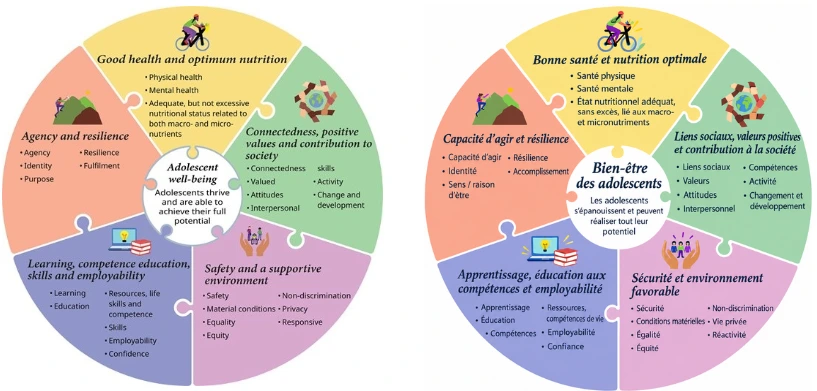
From October 2022 to October 2023, the secretariat of the Partnership for Maternal, Newborn and Child Health (PMNCH) conducted the What Young People Want survey, in preparation for the Global Forum for Adolescents in 2023, with particular attention to low- or middle-income countries (p. ii5–ii6). Young people aged 10 to 24 were invited to complete the sentence "To improve my well-being, I want…", using a WhatsApp chatbot or during in-person collections organised in 16 countries (p. ii5–ii6). The article mentions 1,510,004 responses collected, of which 1,509,904 were classified. The responses were analysed by themes and using automatic language processing methods, according to the 5 domains and 27 sub-domains of the United Nations adolescent well-being framework (p. ii4–ii6). Respondents came from 89 countries; over 99.9% were from low- or middle-income countries. In total, 90.4% were aged between 15 and 24 and 50.5% identified as female (p. ii4). The article presents the results by domain, sub-domain, age, region and gender, then discusses the limitations of the survey. The authors believe that policymakers and programme managers need to understand the views of young people and take them into account (p. ii14).
2️⃣ WHAT TO REMEMBER
1️⃣ Education comes first, but the five areas are represented (finding). In table 3 and figure 3, the area "learning, skills, education and employability" accounts for 36.4% of the wishes, ahead of "safety and a favourable environment" (28.4%) and "good health and optimal nutrition" (20.9%). However, the summary of the article gives 36.3% for the education area: this internal divergence is noted below. The five areas are mentioned in the four regions of the WHO that are best represented (p. ii8, ii10–ii11, ii15).
2️⃣ Priorities vary by region and gender (finding). In the Eastern Mediterranean region, health comes in first place (51.1%) and education in third (11.9%), in contrast to the trends observed in Africa, Southeast Asia and the Americas (p. ii8, ii12–ii13). The text of the article also indicates that young people grouped in the category "other genders or undisclosed gender" more frequently cite safety, as well as connection to others, positive values and contribution to society; an inconsistency exists between the text and the presentation of table 5, detailed below (p. ii13–ii14).
3️⃣ A large-scale survey, but with explicit limits (finding). The automatic ranking was manually verified on 100 responses: complete agreement for 49, partial agreement for 20 and disagreement for 31 (p. ii6, ii15). This spot check does not constitute a validation of the entire ranking. The sample is based on volunteering and self-selection; the authors indicate that the survey provides very little information about young people in Europe, the Western Pacific and high-income countries (p. ii14).
3️⃣ TO ACT
1️⃣ Explore the survey dashboard (tool mentioned in the article). It allows for a search by country and/or domain and displays up to 1,000 responses per search. The results displayed are preliminary and prior to data cleaning; they should therefore be interpreted with caution. The article also mentions a detailed report (p. ii5, ii16).
2️⃣ Take into account the wishes of young people in policies and programmes (recommendation from the authors). They request that the views of young people be integrated into the design, implementation, and evaluation of programmes (p. ii4, ii14). This recommendation does not mean that the survey represents all young people: young people from Europe and those from high-income countries are very underrepresented (p. ii14).
3️⃣ Prepare for future collections that are more representative (recommendation from the authors). For a survey aiming for global representativeness, the authors propose to strengthen in-person mobilisation in the six WHO regions and to conduct digital mobilisation in the main languages of the world (p. ii14). Health Practices Suggestion: the unique open-ended question could inspire a local collection of young people's voices, in addition to other methods adapted to the context.
4️⃣ 3 PRACTICAL QUESTIONS
1️⃣ Do these results apply to young people in Europe? Not in a generalizable way. Only 138 respondents came from the Europe region, or less than 0.1% of the sample; the authors indicate that the survey provides very little information about this region and about young people from high-income countries (p. ii4, ii6, ii14).
2️⃣ How to reach young people without a smartphone or internet access? In 16 countries, trained community mobilisers organised collections in various locations, including schools, places of worship, sporting events, and at people's homes. Young people could write their responses on paper; a mobiliser would then input them. Responses could be written in any language. For those under 16, the article specifies that there was no direct digital response and that parental or guardian consent was required (p. ii5–ii6).
3️⃣ Does the survey explain why young people express these wishes? No. The responses are short and often limited to a sentence, with no opportunity for elaboration. The authors believe that additional qualitative research would be necessary to understand the reasons underlying the expressed wishes (p. ii15).
5️⃣ TO GO FURTHER
📝 Health Practices Blog — the mental health theme - https://www.pratiquesensante.com/blog/tag/sante-mentale-35 on the theme of young people - https://www.pratiquesensante.com/blog/tag/jeunes-81
🌍 External resource — WHO / PMNCH and partners, Guidance for countries to assess adolescent health and well-being, 12 May 2025, 50 pages and Excel tool. According to the publisher's page, this guide is based on the same UN framework related to adolescent well-being and helps compile and use data on adolescents. External resource consulted :
https://www.who.int/publications/i/item/9789240107847https://www.who.int/publications/i/item/9789240107847
6️⃣ #️⃣ HASHTAGS
#healthpractices #YouthHealth #Wellbeing #YouthParticipation #YouthVoice #HealthPromotion #GlobalHealth #Adolescents
To go further, order a research or documentary watch
This article : An editorial production based on
experience enhanced by artificial intelligence - The English version of the site is an automatic translation: the French version prevails - Click on the image