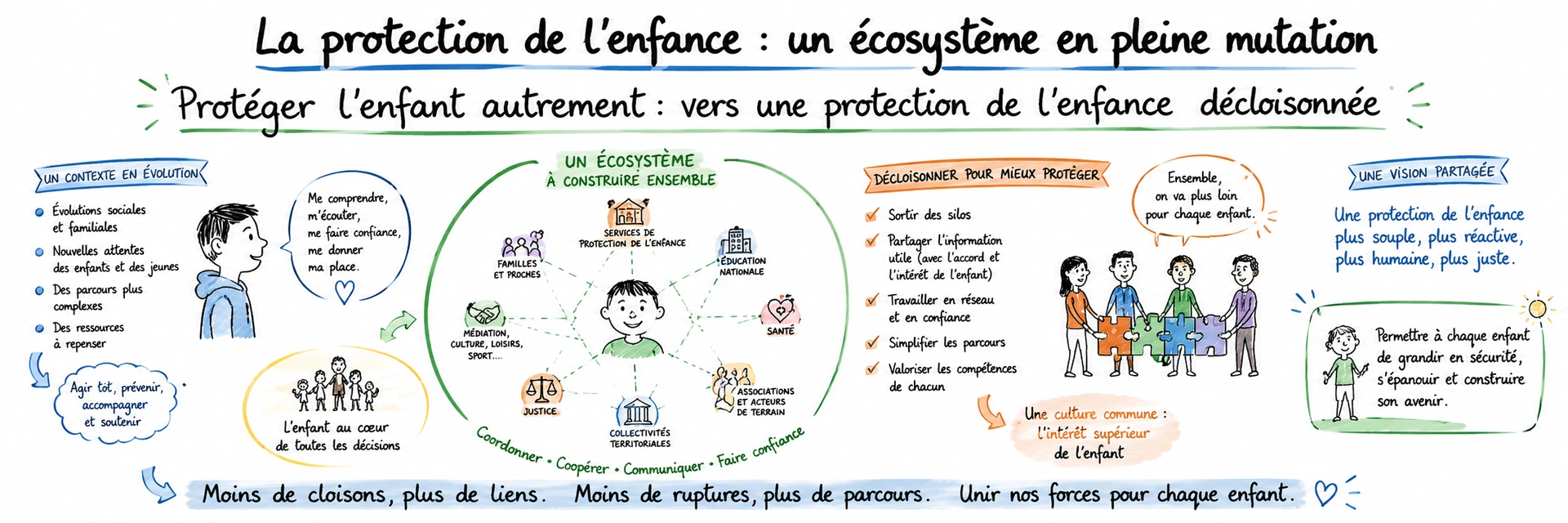
Child protection: an ecosystem in full transformation
Protecting the child differently: towards a decompartmentalised child protection
Daniel Oberlé - Practices in Health - 30 June 2026
This article is based on the resources progressively referenced in the Practices in Health blog. It is a synthesis work, so it is necessary to consult all the sources in the bibliography to go further. Other publications addressing this topic may enrich this selection and contribute to the updating of this page. You can propose your own articles by clicking on "Contact" at the top of the page.
The list of articles on this theme in Practices in Health is at the bottom of this article in the bibliography
We rely on your perspective to enrich this work. Thank you for sharing your comments and suggestions in the form at the bottom of the page, and for proposing other articles that deserve to be analysed and included in this synthesis.
This article is a synthesis work. It is based on the resources progressively referenced in the Practices in Health blog and therefore makes no claim to exhaustiveness: to go further, it remains essential to consult all the sources in the bibliography at the end of the page. Other publications may, tomorrow, enrich this selection and contribute to updating this work.
That’s precisely why your perspective matters. Do not hesitate to share your comments and suggestions in the form at the bottom of the page, and to let us know of other articles that deserve to be analysed and integrated into this synthesis.
Here you will find an analytical and structured reading of the recent developments in child protection, built from a body of institutional reports, recommendations, and scientific works compiled up to the date of publication. The approach is that of a critical synthesis: while the sources used are based on objective data, their contextualisation, their articulation, and the interpretations proposed are from the author's perspective. The aim is not to provide a neutral and comprehensive overview, but to highlight key themes, identify convergences, and illuminate the current issues in the sector from a situated reading.
Introduction
Child protection encompasses all policies, systems, and interventions aimed at preventing family difficulties, supporting vulnerable populations, and safeguarding minors in danger — or at risk of being so. In France, its legal framework, reinforced by the laws of 2007 [37], of 2016 [38] and by the Taquet law of 2022 [39], rests on two complementary pillars: prevention, which supports families before crises occur, and administrative and judicial protection, which can lead, when necessary, to placement.
The key figure. The National Observatory for Child Protection records approximately 400,000 minors and young adults benefiting from a measure, with very variable support rates from one department to another — the sign of an uneven response across the territory [1].
The crisis in figures. By 2024, 392,600 minors and young adults benefit from at least one measure of ASE, representing an increase of 1.5% compared to 2023. At the same time, human resources are eroding in the opposite direction: the proportion of placed children living with a foster carer has fallen from 56% in 2006 to 35% by the end of 2024, and the candidates for the State Diploma of foster carer have dropped by more than 12% in just one year (2,200 candidates in 2024 compared to 2 500 in 2023). As for the turnover in child protection professions, it exceeds 30% — a figure that speaks, better than any discourse, to the extent of the crisis [41].
This mission relies on a shared responsibility among several levels of actors. The departmental councils are the legal pivot: they manage Child Social Aid (ASE), finance and authorise operators, and coordinate the pathways. But other local authorities play a crucial, often underestimated role. The municipalities and intercommunalities, which became in January 2025 the organising authorities for the care of young children, carry through their CCAS an essential part of early identification and support for families. The specialised prevention, jointly funded by the departments and certain municipalities, supports the most vulnerable areas. Finally, the authorised associations — MECS, AEMO services, living spaces — are the direct operators, on a daily basis. This multi-layered architecture is the concrete reality of the system; it is, however, rarely referred to as such in the major reform texts.
An unprecedented institutional mobilisation. Since 2024, the sector has been experiencing an unprecedented documentary effervescence. The multiplication of institutional reports, recommendations from the High Authority of Health (HAS), opinions from the CIIVISE, and new regulatory provisions testify to a collective mobilisation that must be put into perspective. From now on, child protection aims to transcend sectoral boundaries: it is no longer considered purely from a social, medical, or judicial angle, but in a holistic manner.
The works gathered here converge towards a principle that is simple to state but complex to deploy: protecting a child means providing them with comprehensive and early responses, tailored to their history and respectful of their voice. This emerging consensus is structured around five key lines of force, which this article proposes to explore one by one before questioning their blind spots..
1. The necessity of a ‘holistic’ and decompartmentalised approach
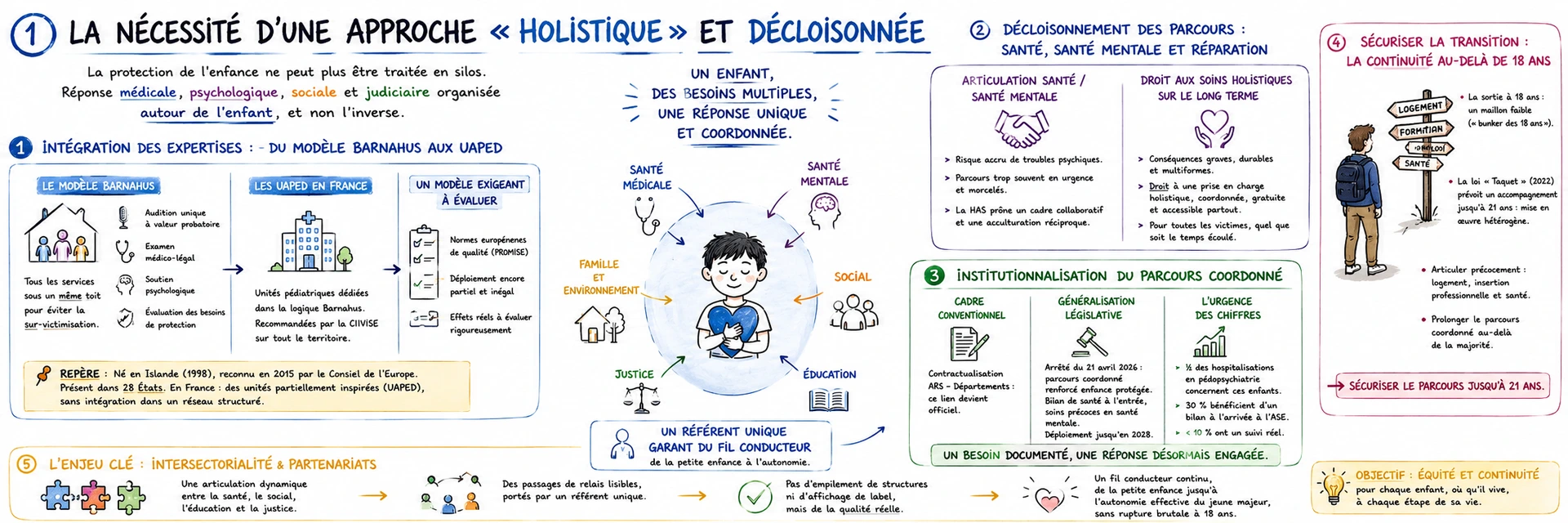
This is the most powerful point of convergence of current works: child protection can no longer be treated in silos. The medical, psychological, social, and judicial responses must be organised around the child, not the other way around.
The integration of expertise: from the Barnahus model to the UAPED
To avoid the over-victimisation — or revictimisation — of minors, a strong trend is emerging: grouping competencies ‘under one roof’.
The model Barnahus, defined by the Council of Europe, proposes a safe and suitable environment that brings together all the relevant services in one place. The aim is to provide a coordinated response and to avoid the reactivation of trauma during the investigation : the child benefits from a hearing according to a probation protocol, a forensic examination, psychological support and an assessment of their protection needs [2]. This model is now a reference, but it describes an ideal type: its concrete implementation remains uneven from one country to another, and its real effects in the long term still require a rigorous evaluation [6][7].
📌 Reference. Born in Iceland in 1998 and recognised in 2015 by the Council of Europe as a promising practice [40], the Barnahus model is now present in 28 states. It is not yet a standard: in France, only units partially inspired by this model (the UAPED) exist, without integration into a structured network.
- The deployment of the UAPED. In France, the Child Protection Reception Unit (UAPED) follows the same logic. The CIIVISE recommends deploying it over the entire territory by directly drawing inspiration from the Barnahus [3]. Its most recent opinion advocates for an integrated care pathway — “the right professional at the right place at the right time” — within a dedicated and graduated paediatric setting, in order to ensure equal treatment of minors throughout France [4].
A demanding model, to be evaluated. Referring is not enough: this model cannot be reduced to a label. The European quality standards (PROMISE) set strict requirements — single hearing with evidential value, therapeutic care for the child as well as for their non-offending relatives, etc. [5]. Two points of caution are necessary. On the one hand, its deployment remains partial and uneven: the European Parliament highlights its limits [6], and the current French news — such as the Lyhanna case — has shed light on the gap between the theoretical model and the reality on the ground [8]. On the other hand, its real effects still require a serious evaluation that goes beyond mere adherence to principle [7]. For health promotion, this retreat is an essential safeguard: targeting real quality and territorial equity, not just appearances.
The breaking down of barriers in pathways: health, mental health and reparation
The articulation of health / mental health. Protected children are at increased risk of mental disorders. However, their access to care is often too urgent and their pathways experience numerous disruptions. In light of this observation, the HAS advocates for a collaboratively constructed framework and mutual acculturation between child protection professionals and those in child psychiatry.[9].
The right to holistic care in the long term. The report on the case of Notre-Dame-de-Bétharram confirms the necessity of this breaking down of silos for the long-term process of repair. In the face of serious, lasting and multifaceted consequences, the commission affirms the right to holistic care — a coordinated, individualised and free pathway articulating the medical, psychological, legal and social aspects —, accessible everywhere. It supports that this right should benefit all victims of childhood violence, regardless of the time elapsed [10].
The institutionalisation of the coordinated pathway
This synergy between health and protection is now expressed in a binding manner in law.
The conventional framework. The instruction for contracting between the regional health agencies (ARS) and the departments formalises this essential link [11].
The legislative generalisation. From May 2024, the National Council for Child Protection (CNPE) called for the generalisation of coordinated pathways by relying on the experiments Protected Health and Pegasus [12]. It is now established: the decree of 21 April 2026 establishes a « enhanced coordinated pathway for protected childhood ». Led by a departmental structure, this system provides for a health assessment upon entry and early mental health care, for a phased deployment until 2028 [13]. There remain questions that cannot be avoided: with what means, and already financed how? And can we reasonably aim for a complete deployment by 2028 when services are understaffed?
The urgency of the figures. The need is well documented: if these children represent half of hospitalisations in child psychiatry, only 30 % of them benefit from an assessment upon their arrival at the ASE, and less than 10 % receive actual follow-up [13].
Securing the transition: continuity beyond 18 years
Breaking down silos loses all its meaning if it is abruptly interrupted at adulthood. The exit from programmes — often referred to as the “18-year-old bunker” — remains one of the weakest links in the system: due o lack of support, many young people then fall into precarity or homelessness.
The Taquet law of 7 February 2022 does indeed establish the obligation to support young adults. But its implementation remains very heterogeneous from one department to another, with some limiting it to a few months when the issue should be to secure the pathway up to 21 years [14][15]. Successfully managing this transition requires early articulation of protection with housing, professional integration, and health. It is this same logic of a coordinated pathway that must be extended beyond minority, in the spirit of the recommendations of the HAS on support towards autonomy [16].
The key issue — intersectorality & partnerships. These devices are the most concrete expression of a living articulation between health, social services, education and justice. The challenge is not to pile up new structures or to display a label, but to ensure clear handovers, led by a single point of reference who guarantees the guiding thread — from early childhood to the effective autonomy of the young adult, without a sudden break at 18.
2. From a curative logic to proactive prevention (“going towards”)
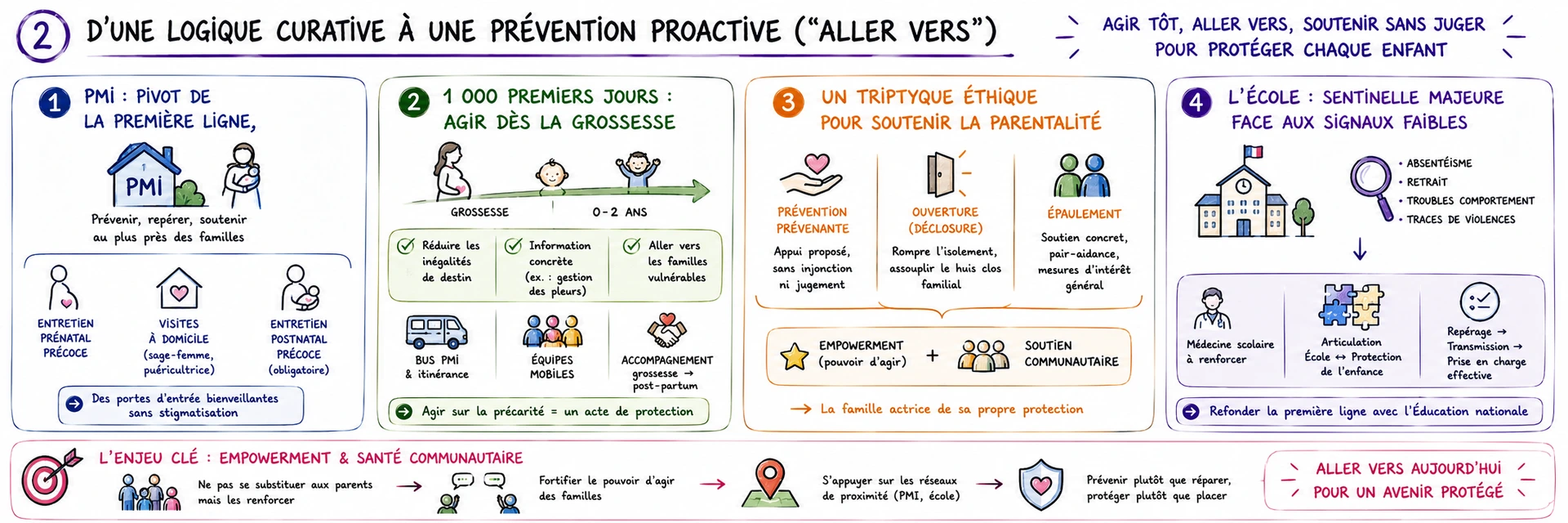
The second point of consensus requires action to be taken as early as possible, to prevent vulnerability from tipping into danger. Prevention no longer waits for families to cross the threshold of a service: it now goes to meet them.
Maternal and Child Protection (PMI), the pivot of the front line
The PMI is reaffirmed as the central actor in local prevention. The contractualisation between the ARS and the departments now sets numerical targets for it to regain its structuring role, through several major levers [11] :
early prenatal care;
home visits conducted by midwives and health visitors;
early postnatal care, now mandatory.
As many welcoming entry points to identify vulnerabilities and support parents without ever stigmatising them.
The structuring approach of the “1,000 first days”
This concept now guides public action, with the ambition of reducing destiny inequalities from pregnancy [11]. The issue is also to prevent tragedies through very concrete information actions: a French study shows that one in two mothers reports having received no plan for managing infant crying by the second month — a lever still under-utilised against shaken baby syndrome [17].
For families in great precariousness, identifying these “weak signals” relies on well-identified outreach strategies: mobile teams, itinerant consultations (like PMI buses), enhanced support from pregnancy to post-partum [11]. Acting directly on precariousness thus becomes a full-fledged act of protection, preventing placement from being imposed as the only available response, due to a lack of alternatives [18].
An ethical triptych for supporting parenthood
The High Council for Family, Childhood and Age (HCFEA) formalised in March 2026 a conceptual framework that fully aligns with this philosophy [36]. Its report invites structuring family support around three complementary axes:
A « preventive prevention » : support offered without injunction or judgement, activated as soon as parents express the need.
The « opening » (disclosure) : a process aimed at breaking isolation and softening the sometimes rigid boundaries of the family cocoon.
The « support » : concrete support, based on measures of general interest and on peer support when situations become complex.
This triptych implements the key concepts of empowerment (strengthening the power to act) and of community support specific to the promotion of health. It repositions the family as an actor in its own protection, contrary to a top-down and purely interventionist approach.
Giving substance to "the support": home assistance devices
This triptych would remain abstract without the interventions that concretely implement it, as close as possible to families. In the Code of Social Action and Families, " the support" takes the form of a graduated palette, most often at home : intervention by social and family intervention technicians (TISF) and social life assistants, home educational assistance (AED), support in social and family economy (AESF), or even educational action in open environments (AEMO) when measures fall under the judicial system. The first step in supporting parenting, the TISF acts at the heart of daily life — childcare practices, domestic organisation, supporting the parent-child relationship — precisely where the "weak signals" that proactive prevention seeks to capture are located. But this first safety net is itself weakened by a serious crisis of attractiveness (see section 3): due to a lack of available professionals, the system intended to prevent many placements is lacking at the very moment it should be in place.
The school: a major sentinel against weak signals
The first place of social life for the child, the school remains the most detailed observatory of weak signals: absenteeism, withdrawal, signs of violence, behavioural issues. No other system reaches, with such regularity and across the entire territory, almost all children aged 3 to 16. This is precisely why the crisis in school medicine is not a sectoral problem: it is a flaw in the early detection system for child protection.
A medical demography in collapse. Two recent reports from the IGAS and the IGÉSR present an alarming observation: the number of school doctors has significantly decreased between 2017 and 2021, and retirements are set to accelerate. The phenomenon is concrete and localized: in Bas-Rhin, the number of school doctors has dropped from 17 in 2022 to 14 in 2024, with a projection of only 4 doctors for the entire academy in the long term. In parallel, there were only 2,600 school social workers across the entire territory in 2022 — a figure notoriously insufficient given the needs.
Almost non-existent medical visits. The medical visit for Year 6, although mandatory, currently concerns only about 20% of students. The visit for 3-4 year olds, intended to allow for early detection of sensory, psycho-affective, and language disorders, is provided by the PMI when possible, by school medicine as a substitute — but very unevenly across territories, at the risk of missing crucial screenings.[19].
What is being done — and what remains insufficient. The "School Health" plan of May 2025 [19]and the School Health Conference [20] have opened operational avenues: administrative simplification to free up medical time, deployment of ‘mental health first aid’ referents in each establishment, training of two adults per establishment in detecting students in distress and directing them to the resource personnel (doctors, nurses, psychologists, social workers). These measures are going in the right direction. But the trade unions unanimously point out that they do not address either the urgency or the scale of the needs on the ground.
What is still missing: the transition from detection to action. Training teachers to detect is not enough if the chain of transmission to child protection remains unclear. The law provides for joint training for different professions on the detection of children in danger [27], but its implementation remains very partial. The issue is not only to have more school doctors: it is to guarantee that a signal detected at school leads effectively to an assessment and, if necessary, to a measure. This link — between school detection and the response from child protection — remains one of the most fragile in the system.
The key issue. The school can only be the sentinel of the system if it has professionals to see, protocols to transmit and interlocutors to act. Without these three conditions met, detection remains an intention without follow-up — and the most invisible children continue to slip through the cracks..
3. The recognition of ‘complex trauma’ and sensitive institutions
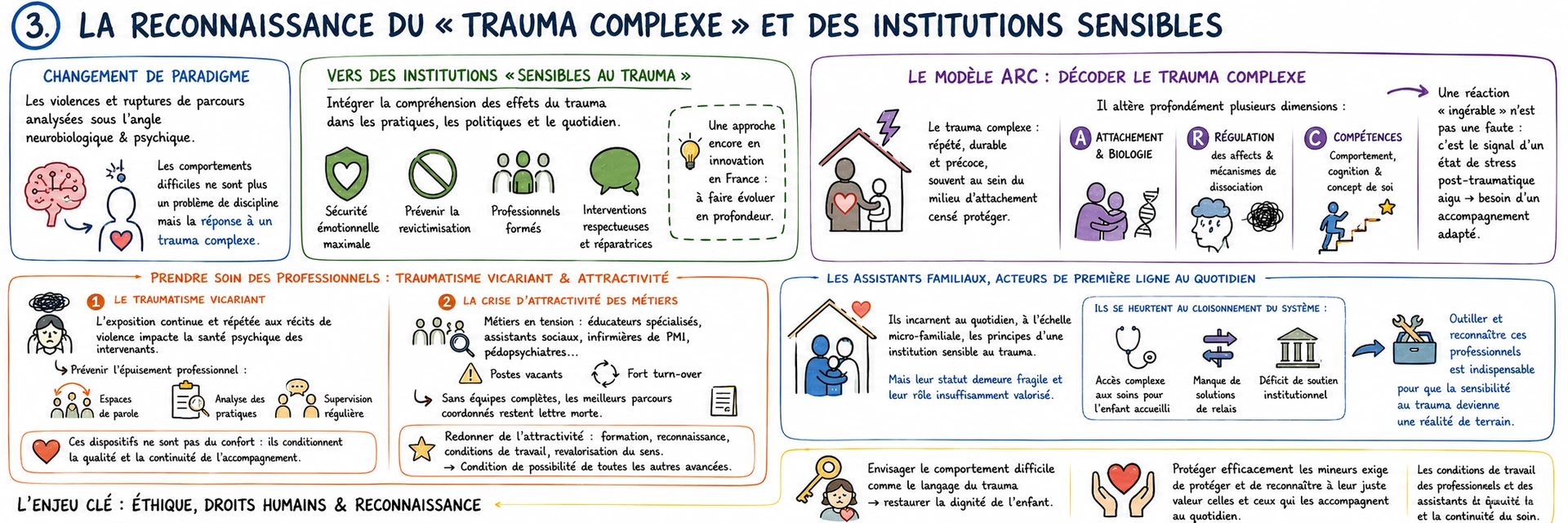
The impact of violence and disruptions in pathways is now analysed from a neurobiological and psychological perspective. Thanks to this paradigm shift, the difficult behaviours of children are no longer read as mere disciplinary problems but are understood in all their complexity.
Towards institutions "sensitive to trauma"
An institution described as "sensitive to trauma" fully integrates, in its practices, policies and daily environment, the understanding of the effects of experienced traumas. Its aim: to guarantee maximum emotional safety and to prevent revictimisation, this new harm that adds to the initial trauma. Professionals are trained to decode the signs of trauma in order to respond with respectful and repairing interventions.[21]. Still considered an innovation "in its infancy" in France, this approach invites a profound evolution of practices towards more humane and more tailored responses.[21].
The ARC model: decoding complex trauma
The ARC framework — Attachment, Regulation, Competence — offers a valuable framework for interpreting the child's reactions.[21]. Unlike a single trauma, complex trauma is characterised by its repeated, enduring and early nature, often occurring within the very attachment environment that is supposed to protect. It profoundly alters several fundamental dimensions: se caractérise par son aspect répété, durable et précoce, survenant souvent au sein même du milieu d’attachement censé protéger. Il altère en profondeur plusieurs dimensions fondamentales :
attachment and the biology of the child;
the regulation of affects and the mechanisms of dissociation ;
behaviour, cognition and the construction of the self-concept [21].
With this framework, a reaction deemed "unmanageable" is no longer a fault to be sanctioned: it becomes the signal of an acute post-traumatic stress state, which calls for appropriate support.
Caring for professionals: vicarious trauma and attractiveness
Vicarious trauma. Continuous and repeated exposure to narratives of violence directly affects the mental health of the interveners. Preventing this exhaustion requires spaces for dialogue, an analysis of practices, and regular supervision, implemented systematically. These measures are not a matter of comfort: they are a sine qua non condition for the quality and continuity of support [21].
The crisis of attractiveness in professions. The health of teams also plays out on a structural level. The sector is going through an acute crisis of vocations and recruitment — specialised educators, social workers, PMI nurses, child psychiatrists — which results in long-term vacant positions and high turnover [22]. However, the best coordinated pathways — like the one established by the decree of April 2026 [13] — remain a dead letter if the teams of the ASE or the care structures remain incomplete. Restoring the attractiveness of these professions — training, recognition, working conditions, regained meaning — is the condition for the possibility of all other advancements [23].
The vicious circle: when the degradation of work feeds the trauma — and the escape
These two phenomena do not simply juxtapose: they feed into each other. Degraded working conditions and a lack of recognition are not just factors of discomfort; they are direct causes of burnout and vicarious trauma. A professional overexposed to stories of violence, deprived of recovery time, of supervision and sufficient staffing, becomes exhausted, then leaves. Their departure increases the burden on those who remain, multiplies the breaks in references for the child — reactivating the very trauma that the institution claims to soothe — and makes the profession even less attractive. The spiral closes [21][22].
Hence a major practical consequence: improving working conditions and recognising these professions is not a peripheral corporatist demand, but a double-edged care measure. The same investment protects the mental health of professionals and guarantees the relational continuity upon which the child's repair depends. Supervision, practice analysis, stable staffing and recognition do not simply add up as distinct items: they are the faces of a single and the same protection policy.
Family assistants, frontline actors on a daily basis
When placement becomes inevitable, the foster carers embody daily, on a micro-family scale, the principles of an institution sensitive to trauma. Their status remains fragile and their role insufficiently valued. They face head-on the compartmentalisation of the system: complex access to care for the child in care, lack of respite solutions, deficit of institutional support [24][25]. Equipping and recognising these professionals of family care is therefore essential for the sensitivity to trauma to move beyond the concept stage and become a reality on the ground.
The key issue — ethics, human rights & recognition. Considering difficult behaviour as the language of trauma, is to restore the dignity of the child. But effectively protecting minors also requires protecting and recognising at their true value those who accompany them day after day. The working conditions of professionals and foster carers directly condition the quality, safety and continuity of care.
4. The emergence of new risks: digital and artificial intelligence
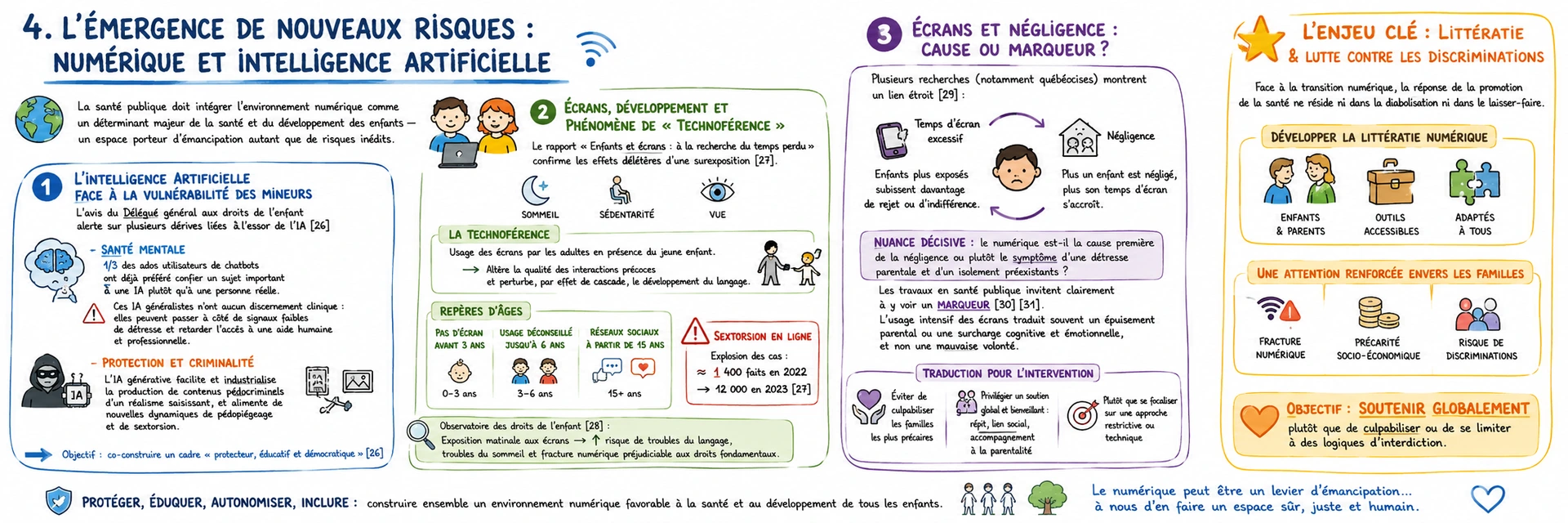
Public health must now integrate the digital environment as a major determinant of the health and development of children — a space that offers both emancipation and unprecedented risks.
Artificial intelligence in the face of the vulnerability of minors
The opinion of the General Delegate for the rights of the child raises the alarm on several drift related to the rise of artificial intelligence [26] :
On mental health. A third of adolescent users of chatbots report having preferred to confide an important subject to an AI rather than to a real person. However, these generalist conversational agents lack any clinical discernment. They may miss the subtle signs of psychological distress and dangerously delay access to human and professional help.
On protection and crime. Generative AI facilitates and industrialises the production of strikingly realistic child sexual abuse content, while feeding new dynamics of grooming and sextortion.
Far from advocating for an illusory general ban or yielding to naive adherence, this opinion advocates for the co-construction of a framework that is both "protective, educational and democratic" [26].
Screens, development and the phenomenon of "technoférence"
The report of the expert commission " Children and screens: in search of lost time " makes observations that are now widely agreed upon [27]. It confirms the deleterious effects of overexposure on the sleep, sedentary behaviour and eyesight of children, and introduces a key concept:
Technoférence : the use of screens by adults in the presence of the young child. This habit profoundly alters the quality of early interactions and disrupts, through a cascading effect, the development of language.
To address this, the report proposes clear age guidelines — no screen time before 3 years, use discouraged until 6 years, access to social networks from 15 years — while highlighting the explosion of online sextortion cases, which rose from about 1 400 incidents in 2022 to 12,000 in 2023 [27]. These data align with the work of the Observatory on Children’s Rights, which links morning exposure to screens with an increased risk of primary language disorders, sleep disorders, and a digital divide detrimental to the fundamental rights of minors [28].
Screens and neglect: cause or marker of family distress?
Several studies, particularly from Quebec, highlight a close link between excessive screen time and situations of neglect: children massively exposed experience more rejection or indifference behaviours and, conversely, the more a child is neglected, the more their screen time increases [29].
A crucial scientific nuance arises: is digital technology the primary cause of neglect, or rather a symptom of pre-existing parental distress and isolation? Public health work clearly invites us to see it as a marker [30][31]. Intensive screen use in a household often reflects parental exhaustion or cognitive and emotional overload, and not a lack of willingness.
The practical translation of this observation is major for intervention : to avoid blaming the most vulnerable families, public action must prioritise global and supportive assistance — respite, social connection, support for parenting — rather than focusing on a single restrictive or technical approach.
The key issue — literacy & combating discrimination. In the face of the digital transition, the response of health promotion lies neither in demonisation nor in laissez-faire. The challenge is to develop the digital literacy of children and their parents through accessible and suitable tools. This requires increased attention towards families weakened by the digital divide and socio-economic precariousness: to support globally, rather than blame or limit oneself to prohibitive logics.
5. Strengthened governance and the voice of the child
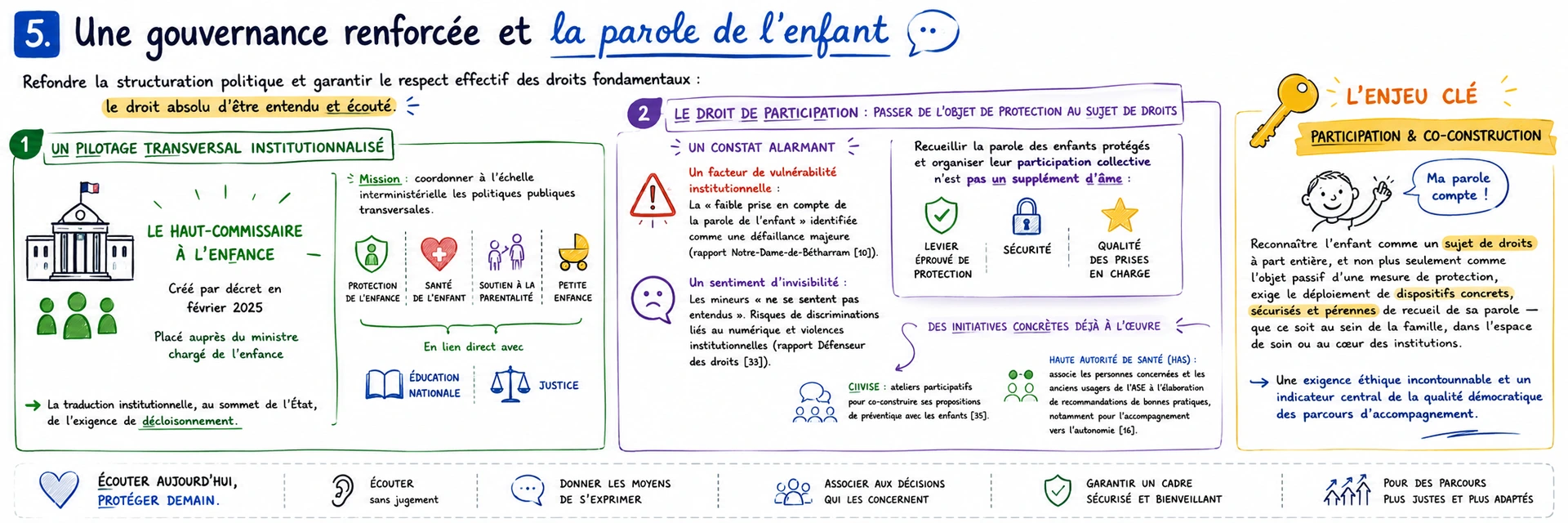
Recent texts and reports finally advocate for a restructuring of political organisation and for an effective respect for the fundamental rights of the child — to begin with the absolute right to be heard and listened to.
The institutionalisation of cross-cutting governance: the High Commissioner for Children
Created by decree in February 2025 and placed under the minister responsible for children, the High Commissioner for Children has the mission to coordinate, at the inter-ministerial level, cross-cutting public policies.[32]. Its area of action encompasses child protection, child health, support for parenting and early childhood, in direct connection with the ministries of National Education and Justice. This creation reflects, at the highest level of the State, the demand for breaking down silos that runs through the entire sector.
The right to participation: moving from the object of protection to the subject of rights
A severe and unanimous observation runs through contributions: the voice of the child remains too often marginalised in decisions that directly concern them.
A factor of vulnerability institutionally. The report on the Notre-Dame-de-Bétharram case explicitly identifies the “low consideration of the child’s voice” as one of the major failings that made possible the violence and its long-term silencing.[10].
A feeling of invisibility. In its report to the UN Committee on the Rights of the Child, the Defender of Rights notes that minors “do not feel heard,” while pointing out the risks of discrimination related to digital issues and the painful reality of institutional violence.[33].
Gathering protected children's voices and organising their collective participation is neither a matter of soul supplement nor a moral posture: it is a proven lever for protection, safety and quality of care.[34].
Several bodies are already translating this principle into action. The CIIVISE, for example, relies on participatory workshops to co-construct its prevention proposals with children.[35]. On its part, the HAS closely involves the people concerned and former users of the ASE in the development of its recommendations for good practices, particularly for support towards autonomy [16].
The key issue — participation & co-construction. Recognising the child as a fully-fledged rights holder, and no longer as the passive object of a measure, requires concrete, secure and sustainable systems for gathering their voice — within the family, in the care space as well as at the heart of institutions. This active participation is both an unavoidable ethical requirement and a central indicator of the democratic quality of support pathways.
6. What the corpus does not yet say: limits and blind spots
The documentary effervescence of 2024-2026 reflects a real awareness. But the profusion of recommendations can also mask deep-seated resistances and persistent blind spots, which the critical reading of the corpus invites us to name without hesitation. My field perspective leads me here to a more critical discourse than just the analysis of the source documents — and I remind that this article was written in the course of the referenced materials, and it calls on readers to provide supplements.
Institutional abuse by saturation
The most critical point lies in the growing gap between judicial decisions and their actual execution. Thousands of children remain exposed to dangerous environments because placement measures or AEMO are not executed, due to lack of places or resources — which some professionals now openly qualify as institutional abuse. To address this shortfall, children are sometimes accommodated in hotels or guesthouses, in structures where the daily rate does not guarantee any quality of educational support.
It is added to by what one might call the ideology of return : the systematic quest for a return to the family, when it is not supported by real assistance, can discourage parents and maintain in the child a chronic emotional instability. The underlying territorial inequality remains structurally intact: two children in identical situations can receive radically different responses depending on their birth department. The Defender of Rights reminded us in its opinion of 26 June 2026 — the laws of 2007, 2016 and 2022 are still not fully implemented across the entire territory. The reform is still awaiting a genuine lever for equalisation.
A deep crisis in the professions
The article mentioned the recruitment crisis and vicarious trauma; we need to go further. The massive reliance on temporary work is one of the most concrete factors of degradation — and the least named: it multiplies breaks in references, prevents the building of trusting relationships and weakens children already affected by complex traumas. Initial training, too general, does not sufficiently prepare professionals for trauma clinics or complex psycho-educational needs. Recommending “ trauma-sensitive institutions” without training the teams that make them work is to stop halfway.
Training: a condition of possibility, not just support
An institution does not become " sensitive to trauma" by decree or by display: it becomes so through the training of its teams. And this is where the problem lies. Initial training in social work and care, still too generalist, addresses little the clinic of psychotrauma, the neurobiology of stress or the concrete tools for regulation (ARC grid, emotional safety, prevention of revictimisation). Without a common foundation shared by all the practitioners — from the educator to the reception officer, from the manager to the foster carer —, the concept remains a veneer: the teams continue to read a state of post-traumatic stress as a "provocation" to be sanctioned. Therefore, deploying trauma-sensitive institutions requires, beforehand, a complete overhaul of the initial training models and to guarantee an effective right to continuing education and to the analysis of practices. Failing that, one prescribes a culture without giving the means [21].
The blind spots of health and care
Despite scientific advances, the care pathway remains a labyrinth. It takes on average ten to thirteen years for a victim of childhood violence to access specialised care. About 79% of healthcare professionals still do not make the link between the violence experienced in childhood and their patients' subsequent health status. And the current systems mainly address the urgency of recent violence: adults with the aftereffects of past trauma often find themselves without an appropriate solution. Finally, placement remains poorly evaluated in its real long-term effects — the overrepresentation of former placed children in precariousness, homelessness and the penal system is a warning signal that the institutional corpus barely mentions.
The territorial millefeuille, a blind spot in governance.
The transformation, in 2025, of municipalities into organising authorities for the reception of young children has redistributed competencies without clarifying the connections with the departments, which remain leaders in child protection. Between the department that decides and finances, the municipality that identifies and directs, the intercommunal structure that sometimes coordinates and the association that supports, the handovers remain vague, and often failing. None of the recent major reports seriously map this architecture — as if territorial governance were an operational detail, and not a fundamental condition for the system's effectiveness.
Persistent invisibilities and blind management
The steering of public policies is still largely done without reliable data. There are no consolidated national data on the reasons for entry into child protection, nor on the overall health of protected children. Statistics over-represent school-aged children and leave the most vulnerable in the shadows: residents of informal settlements, unaccompanied minors, out-of-school children. Adoption breakdowns and failures constitute another major unthought — a source of deep trauma, and yet absent from most recent reports.
The limits of regulation in the face of new risks
Legal frameworks, such as the European AI Act, mainly target institutional uses of artificial intelligence. The daily uses by children — chatbots used as emotional substitutes, exposure to synthetic content — still largely escape effective protection mechanisms. More structurally, the system addresses the consequences (the danger) without acting on the root cause: the economic and social precariousness. The breaking down of silos between poverty reduction policies and child protection remains the major absent in all the convergences described here. And behind each of these limits, a budgetary question that institutional reports carefully sidestep: recommending without quantifying is also a form of blind spot.
In conclusion: five convergences, one same compass — and resistances not to be minimised
Breaking down silos, proactive prevention, trauma-informed reading, digital vigilance, governance and participation: these lines of force are not isolated projects. They outline the facets of a single and same paradigm shift — moving from a protection that reacts, segments and decides for the child, to a protection that anticipates, articulates and decides with him.
But this consensus, as solid as it may be in terms of principles, stumbles upon realities that the previous section attempted to name: institutional abuse by saturation that no one politically assumes, a placement system poorly evaluated in its real effects, families summoned in speeches but rarely co-actors, a voice of the child proclaimed but still rarely enforceable, and a structural funding that reports carefully refrain from quantifying.
The risk would be to let the consensus of convergences serve as policy — to multiply recommendations without confronting the conditions for their implementation:
The requirement for rigor : measures evaluated on their real effects, and not on their labeling.
The human valuation : trained, stable professionals, in sufficient numbers — and not replaced by temporary workers who break the ties that the system claims to build.
The end of age breaks : a continuity that does not collapse at 18 years, nor at each change of reference.
The educational alliance : a school and a fully integrated school medicine, and not simply mentioned.
Effective territorial equity : not as an indefinite horizon, but as a quantified, controlled and guaranteed objective.
For all actors in health, social services and education, the compass remains clear: to converge expertise around the real needs of the child, to strengthen the agency of families, to anchor responses in the territories, and to place the voice of the child at the centre — even when it is uncomfortable.
The insight of the Defender of Rights: evaluate before legislating
These convergences find a significant institutional confirmation in theOpinion no. 26-06 of the Defender of Rights (26 June 2026), issued on the draft law concerning the protection of children currently under review. Its three reminders resonate directly with the blind spots identified here:
Evaluate before legislating : priority must be given to the evaluation of existing reforms before any new legislative developments.
Apply existing law : the laws of 2007, 2016 and 2022 are still not fully applied across the entire territory.
Move from texts to reality : the difficulties in the sector are not due to legal gaps, but to the concrete application of the texts — and to the need to restore meaning, resources and serenity to educational work.
Daniel Oberlé - Practices in Health
This article offers an analytical and structured reading of the recent developments in child protection, based on a corpus of institutional reports, recommendations, and scientific works compiled up to the publication date by the Pratiques en Santé website. It is therefore far from exhaustive: this is also why we are calling on readers to propose resources and update this work subsequently (see the proposal form at the bottom of this page).
All sources present in Pratiques en Santé - https://www.pratiquesensante.com/blog/tag/protection-de-l-enfance-46
Order of a personalised monitoring - https://www.pratiquesensante.com/blog/annonces-28/offre-de-service-recherche-et-veille-documentaire-personnalisee-1491
To consult the other themes of the Open Notebooks of Pratiques en Santé: https://www.pratiquesensante.com/blog/actualites-17/les-cahiers-ouverts-de-pratiques-en-sante-5998
Sources and references
References cited in order of appearance. The resources from the corpus Pratiques en Santé (keyword “child protection”) are supplemented by the main institutional reports published from 2024 to 2026.
[1] ONPE / France Enfance Protégée — Child protection and abuse: state of affairs 2025 (December 2025). https://www.pratiquesensante.com/blog/pratiques-15/protection-de-l-enfance-et-maltraitances-etat-des-lieux-2025-rapport-public-donnees-chiffrees-6011
[2] Council of Europe — Protection of children against exploitation and sexual abuse: a multidisciplinary and inter-institutional response inspired by the Barnahus model (Lanzarote Convention). https://edoc.coe.int/fr/droits-des-enfants/11822-protection-des-enfants-contre-lexploitation-et-les-abus-sexuels-une-reponse-adaptee-aux-enfants-pluridisciplinaire-et-interinstitutionnelle-inspiree-du-modele-de-barnahus.html
[3] CIIVISE — Assessment of the implementation of recommendations related to incest and sexual violence against children (UAPED, Mélanie rooms, Barnahus, NICHD protocol), 2026. https://www.pratiquesensante.com/blog/pratiques-15/analyse-de-la-mise-en-%C5%93uvre-des-recommandations-de-la-ciivise-le-bilan-de-mise-en-oeuvre-des-82-recommandations-5986
[4] CIIVISE — Opinion “For a coordinated health pathway, concerned with the best interests of the child victim of sexual violence or incest” (December 2025). https://www.ciivise.fr/la-ciivise-rend-public-ce-jour-un-avis-intitule-pour-un-parcours-de-sante-coordonne-soucieux-de-linteret-superieur-de-lenfant-victime-de-violences-sexuelles-ou-dinceste-constats-et-analyses
[5] PROMISE — Quality standards for Barnahus services (European standards: preliminary hearing, medical examination, therapeutic care, assessment of protection needs). https://www.barnahus.eu/en/wp-content/uploads/2020/09/PROMISEStandards_FR.pdf
[6] European Parliament (EPRS) — Child-friendly justice (briefing, 2025): Barnahus as a good practice and limits of implementation. https://www.europarl.europa.eu/RegData/etudes/BRIE/2025/769554/EPRS_BRI(2025)769554_EN.pdf
[7] IPRS — The Barnahus Model: complete report (critical analysis and literature review; necessity to evaluate the effects). https://www.iprs.it/wp-content/uploads/2021/09/The-Barnahus-Model-COMPLETE.pdf
[8] La Croix — Lyhanna Case : the Barnahus, the Icelandic model for better addressing violence against minors (June 2024).https://www.la-croix.com/societe/affaire-lyhanna-les-barnahus-le-modele-islandais-pour-mieux-traiter-les-violences-sur-mineurs-20260609
[9] HAS — Coordination between child protection and child and adolescent psychiatry (good practice recommendations, April 2025). https://www.has-sante.fr/jcms/p_3261731/fr/coordination-entre-protection-de-l-enfance-et-psychiatrie-de-l-enfant-et-de-l-adolescent
[10] Inquiry Commission / report regarding the Notre-Dame-de-Bétharram case — Recommendation No. 6: effective access to a holistic care approach for victims (coordinated medical, psychological, legal and social pathways). https://www.pratiquesensante.com/blog/pratiques-15/betharram-ce-que-cette-affaire-change-concretement-pour-nos-pratiques-de-terrain-en-protection-de-l-enfance-5994
[11] Inter-ministerial instruction regarding the ARS–Department contractualisation in child prevention and protection — BO Health-Social Protection-Solidarity No. 2025/10 of 28 May 2025 (PMI, pre and postnatal pathways, first 1,000 days). https://www.directions.fr/PageFiles/9378/ContractualisationASE.pdf
[12] CNPE — Recommendation 2024-01 of 13 May 2024: coordinated care pathways for protected children (Protected Health and Pégase experiments). https://www.france-enfance-protegee.fr/wp-content/uploads/2024/05/Parcours-de-soins-pour-les-enfants-proteges-Reco-CNPE-2024-01.pdf
[13] Order of 21 April 2026 establishing the enhanced coordinated pathway "protected childhood" (departmental coordination, health assessment at entry, early mental health care, deployment until 2028). https://www.legifrance.gouv.fr/jorf/id/JORFTEXT000053957729
[14] Defender of Rights — Young adults leaving child welfare: insufficient protection and territorial inequalities. https://www.defenseurdesdroits.fr/jeunes-majeurs-sortant-de-laide-sociale-lenfance-une-protection-insuffisante-et-des-inegalites-1039
[15] Children's Rights — Implementation of the "Taquet" law: supporting young people until they are 21 years old, and not for 21 months (2025). https://www.droitdenfance.org/2025/02/06/mise-en-oeuvre-de-la-loi-taquet-accompagnez-les-jeunes-jusqua-leurs-21-ans-et-non-pendant-21-mois/
[16] HAS — Improving care upon leaving child protection systems: support towards independence (good practice recommendations, 6 February 2024). https://www.has-sante.fr/jcms/p_3352139
[17] Goethals L. et al. — Lack of delivery of an infant crying plan to women who gave birth in France: frequency and determinants, Child Abuse & Neglect, 2025. https://www.sciencedirect.com/science/article/pii/S0145213425004533
[18] CNAPE — From prevention to intervention: acting on precariousness to protect the child. https://www.pratiquesensante.com/blog/pratiques-15/de-la-prevention-a-l-intervention-agir-sur-la-precarite-pour-proteger-l-enfant-4759
[19] Ministry of National Education — School health: acting for students, at the heart of the School (presentation document, May 2025). https://www.pratiquesensante.com/blog/politiques-10/sante-scolaire-agir-pour-les-eleves-au-c%C5%93ur-de-l-ecole-4790
[20] School Health Conference — minutes of the session of 1 July 2025. https://snalc.fr/assises-de-la-sante-scolaire-cr-1-juillet-2025/
[21] CNAPE — Complex traumas: for trauma-sensitive institutions in child protection, May 2025 (trauma-sensitive approach, ARC model, vicarious trauma). https://www.pratiquesensante.com/blog/outils-6/les-traumatismes-complexes-pour-des-institutions-sensibles-en-protection-de-l-enfance-5182
[22] Weka — Child protection, a sector in acute crisis, in search of human resources. https://www.weka.fr/actualite/protection-de-lenfance/article/la-protection-de-l-enfance-un-secteur-en-crise-aigue-en-quete-de-re-228101
[23] CNAPE — Relaunching attractiveness of child protection professions (contribution to IGAS), February 2022. https://www.cnape.fr/documents/cnape_contribution-igas_fevrier2022/
[24] Senate — Foster carers, essential actors in child protection (bill proposal, the essentials). https://www.senat.fr/lessentiel/ppl23-522.pdf
[25] Famidac — 2024 : Foster carers, same concerns. https://www.famidac.fr/?2024-Assistants-familiaux-memes-soucis
[26] General Delegate for the rights of the child — Opinion on the risks of artificial intelligence for children's rights, 4 June 2026. https://www.defenseurdesenfants.be/sites/default/files/inline-files/20260604-avis-du-delegue-general-relatif-aux-risques-de-l-intelligence-artificielle-pour-les-droits-de-l-enfant.pdf
[27] Commission of experts — Children and screens: in search of lost time, April 2024. https://www.vie-publique.fr/rapport/293978-exposition-des-enfants-aux-ecrans-rapport-au-president-de-la-republique
[28] Report from the Observatory of children's rights 2026 (early exposure to screens, language and sleep disorders, digital divide). https://www.pratiquesensante.com/blog/chiffres-16/rapport-de-l-observatoire-des-droits-de-l-enfant-2026-5634
[29] Quebec Statistics Institute — Violence and neglect towards children in Quebec (2024): parental attitudes and practices, 5th edition. https://www.pratiquesensante.com/blog/etudes-5/violence-et-negligence-envers-les-enfants-au-quebec-2024-attitudes-et-pratiques-parentales-5e-edition-5285
[30] INSPQ — Screens in the family. https://www.inspq.qc.ca/ecrans-hyperconnectivite/famille
[31] CIUSSS of the Capitale-Nationale (Quebec) — What is the impact of screen use by parents of young children? (GMTP 2024). https://www.ciusss-capitalenationale.gouv.qc.ca/sites/d8/files/Microsites/EQDEM/gmtp/GMPT2024_Usage-parental-ecrans.pdf
[32] Decree No. 2025-118 of 10 February 2025 establishing a high commissioner for children. https://www.legifrance.gouv.fr/jorf/id/JORFTEXT000051151732?__cf_chl_f_tk=xVFG2D8SUu1fIgUTsavDGRRxcs32yXW8cyrOfEzbALU-1782901656-1.0.1.1-bA8CB.gZas9gBa3kbdzM7g1YX9nvUzjRhJ55P.yTfw4
[33] Defender of Rights — Report to the UN Committee on the Rights of the Child (6th periodic review of France, 2025). https://www.vie-publique.fr/rapport/275434-rapport-defenseur-des-droits-au-comite-des-droits-de-lenfant-onu
[34] ONPE — Listening to act : the collective participation of protected children. https://onpe.france-enfance-protegee.fr/document/ecouter-pour-agir-la-participation-collective-des-enfants-proteges-version-integrale/
[35] CIIVISE — Progress Report, October 2024 (participatory workshops with children and adolescents on prevention). https://www.ciivise.fr/rapport-detape-doctobre-2024
[36] HCFEA (High Council for the Family, Childhood and Age) — Helping parents to help children grow. Report adopted by the Council for Childhood and Adolescence, March 2026 (triptych “preventive prevention / disclosure / support”). https://www.pratiquesensante.com/blog/pratiques-15/aider-les-parents-a-aider-les-enfants-a-grandir-5897
[37] Law No. 2007-293 of 5 March 2007 reforming child protection - https://www.legifrance.gouv.fr/loda/id/JORFTEXT000000823100
[38] Law No. 2016-297 of 14 March 2016 relating to child protection - https://www.legifrance.gouv.fr/jorf/id/JORFTEXT000032205234
[39] Law No. 2022-140 of 7 February 2022 relating to the protection of children (Taquet law) - https://www.legifrance.gouv.fr/jorf/id/JORFTEXT000045133771
[40] The Barnahus model helps to avoid the feeling of re-victimisation of children who have suffered sexual abuse, state the leaders of the Council of Europe: https://www.coe.int/fr/web/portal/-/barnahus-model-helps-children-who-suffered-sexual-abuse-from-feeling-like-victims-for-a-second-time-say-council-of-europe-leaders
[41] By the end of 2024, 392,600 children and young people under 21 will benefit from a social assistance measure for children - : https://drees.solidarites-sante.gouv.fr/communique-de-presse-jeux-de-donnees/jeux-de-donnees/fin-2024-392-600-enfants-et-jeunes-de-moins-de
N.B. : Each article is produced from my field experience, combining critical reading and processing by artificial intelligence (Perplexity, NotebookLM and Claude). The prompts are specifically constructed for each type of use, and the models only operate from the transmitted source (that of the blog) — without resorting to external knowledge or extrapolation.
Your comments
We rely on your insights to enrich this work. Thank you for sharing your remarks and suggestions in the form at the bottom of the page, and for proposing other articles that deserve to be analysed and included in this synthesis.