
🚨 From urban planning to local health contracts: the One Health principle knocks at the door of the law
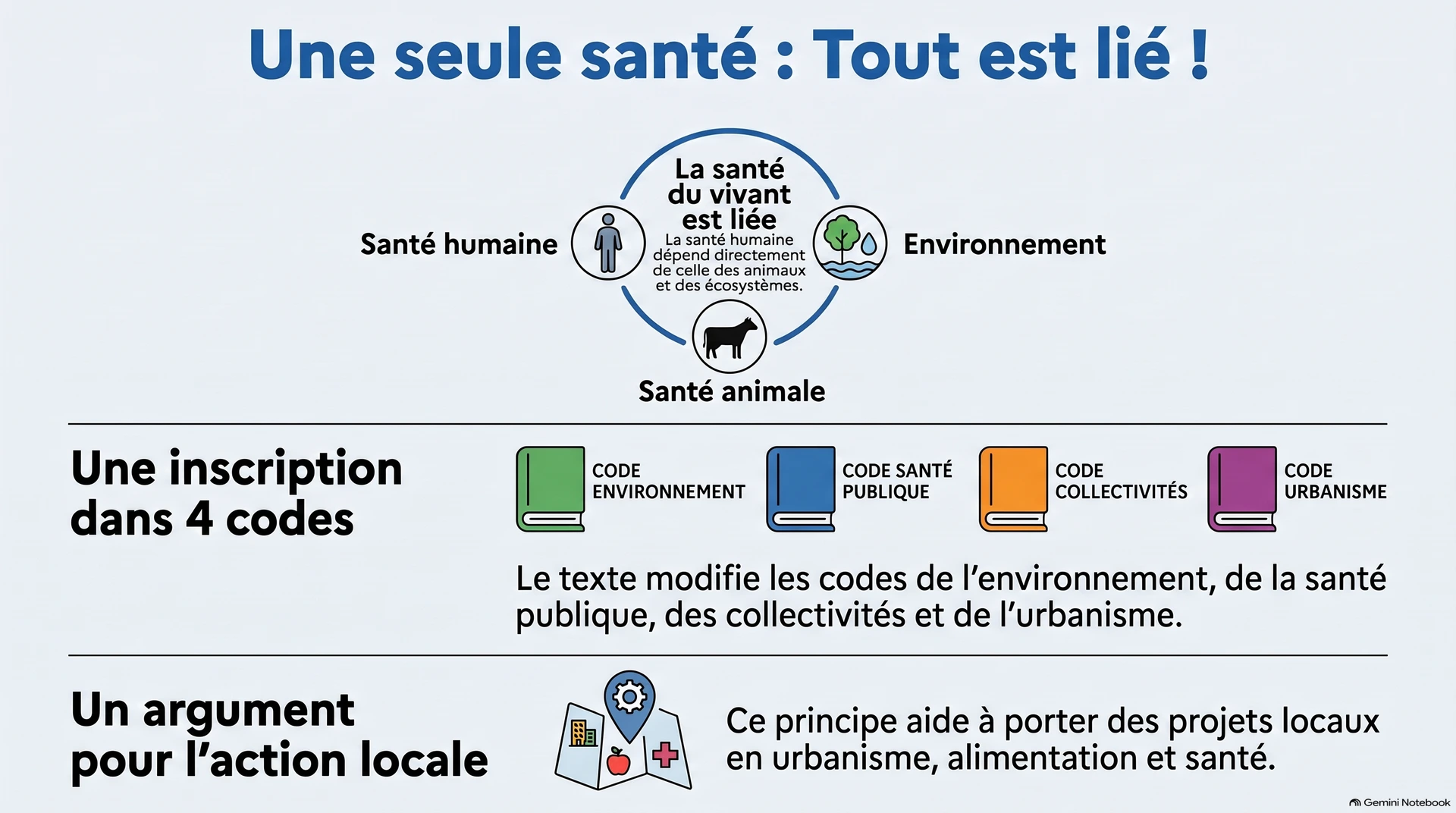
🔍💡 One Health / One Health: a senatorial draft law (July 2026) aims to enshrine the principle in the codes of the environment, public health, local authorities, and urban planning. 🌿 A text still at the deposit stage, but a useful argument and legal overview for local health-environment projects.
📌 This text proposes to elevate "One Health" from the status of concept to that of a principle enshrined in four codes: environment, public health, local authorities, and urban planning. For those setting up a local health contract, a territorial food project, or a health-environment action, it provides a structured argument and a state of play of existing texts, usable now in advocacy or steering committee. It also allows for anticipating what local action could become if the principle were adopted — subject to its examination, still to come.
Source :
📒 Draft law aimed at legally recognising the principle of "One Health"
✍️ Ms. Nicole Bonnefoy, Marion Canalès, Mr. Michaël Weber and Jean-Claude Tissot, senators. July 2026📜🔗LINK to the source
1️⃣ Analytical summary
A legal response deemed "fragmentary" in the face of ecological and health crises
The authors start from heatwaves, the collapse of biodiversity, inter-species pathogens, antibiotic resistance, vector-borne diseases and contaminants (pesticides, pollutants) to note a political and legal response that they consider fragmentary (p. 3-4). They recall the international definition of the "One Health" approach promoted by OHHLEP under the aegis of the quadripartite WHO-OIE-FAO-UNEP (p. 4-5), then list what already exists in France: PNSE 4 (2021), exposome in the public health code (2016), mention of "one health" in the rural code since the agricultural orientation law of March 2025, One Health summit in Lyon (April 2026), opinion of the CESE (p. 5-6). According to them, these advances remain scattered and do not define the principle (p. 6-7).
A principle defined once, then declined in four codes
The dispositif consists of three articles. Article 1 defines the principle in the environmental code: interdependence of the health of living beings and ecosystems, consideration of planetary boundaries, and health understood as "complete state of well-being of living beings, present and future"; it adds it to the areas of state health policy (p. 9). Article 2 provides for its integration into the development and implementation of public policies, according to conditions referred to a decree (p. 9). Article 3 extends it to the action of local authorities and the objectives of urban planning (p. 9-10). The text does not provide for means, indicators, or a timetable: its concrete scope would depend on the decree and jurisprudence.
2️⃣ Key points of the document
1️⃣ A legal definition that broadens the notion of health
Article 1 proposes to understand health as a complete state of well-being of all living beings, present and future — an extension of the WHO formula from 1948 to non-humans and future generations. This is a proposed definition, the legal scope of which remains to be tested (p. 9).
2️⃣ Four codes modified by reference to a single definition
Environmental Code (art. L. 110-1, L. 110-2 and new L. 110-8), Public Health Code (art. L. 1411-1, 12°), General Code of Local Authorities (art. L. 1111-2) and Urban Planning Code (art. L. 101-2, 9°) all refer to the same 6° bis: an architecture aimed at coherence (p. 9-10).
3️⃣ An implementation referred to regulatory power
The integration of the principle into "the development, planning and implementation of public policies" would take place "under conditions set by decree" (new art. L. 110-8, p. 9). Without this decree, the operational effect of the principle could remain limited.
4️⃣ Local authorities and urban planning placed at the centre
The text targets all levels without favouring one, on the grounds that each acts on social, economic or environmental determinants of health; it adds "One Health" to the objectives of public action in urban planning (p. 7, 10). The presentation relies on the example of Nouvelle-Aquitaine and on a senatorial report on prevention (p. 6-7).
5️⃣ An overview of existing texts and initiatives
The explanatory statement constitutes a dated and sourced synthesis: PNSE 4, Green Data for Health programme of ANSES, Lyon Commitments (7 April 2026), PFAS law of 27 February 2025, cadmium PPL, opinion of CESE, resolution "great national cause 2026", article L1 of the rural code (pp. 5-6).
3️⃣ Action points for local stakeholders
These points fall under an indirect utility: the text is not adopted. They rely on the objectives it displays and, for the tools, on the external references of section 4.
1️⃣ Mobilise the explanatory statement as a lobbying argument
The inventory on pp. 5-6 (PNSE 4, rural code, Lyon Commitments, opinion of CESE) can support a request to include a "One Health" axis in a CLS, a PCAET or a territorial food project, by citing the texts already in force rather than the PPL itself.
2️⃣ Re-read the ongoing projects with a "One Health" framework
The definition of article 1 (p. 9) — human, animal, plant health and ecosystems — can serve as a checklist to identify the forgotten dimensions of an action. The analysis grid of ARS Bourgogne-Franche-Comté (annex 3 of its guide, section 4) provides concrete tools.
3️⃣ Anticipate the urban planning aspect
The proposed addition to article L. 101-2 of the urban planning code (p. 10) invites stakeholders to engage with urban planning services during the revisions of PLU(i) or SCoT, particularly through health-promoting urban planning or health impact assessment.
4️⃣ Make the link with the social determinants of health
The report mentions the determinants "social, economic or environmental" (p. 7) without addressing the inequalities of exposure. Unmet need: to integrate equity (exposed neighbourhoods, vulnerable populations) into every local adaptation; the guide "One Health in the City" dedicates an entire section to it.
5️⃣ Organise a monitoring of the text's progress
Follow the legislative file (senat.fr, ppl25-899, RSS feed available) and, in case of adoption, the implementing decree provided for in article 2 (p. 9), which would determine the actual obligations.
6️⃣ Train the teams and elected officials on the concept
The text assumes a common culture that is still not widely disseminated. The documentary file from Promotion Santé BFC (section 4) offers definitions, examples of actions and educational tools that can be mobilised in training or in raising awareness among elected officials.
4️⃣ Additional references
Internal references Health Practices: One Health – One Health: from concept to field practices - https://www.pratiquesensante.com/une-seule-sante-one-health
1️⃣ ARS Bourgogne-Franche-Comté — Think globally to act locally. Methodological guide "One Health" (March 2026, 52 p.)
Guide co-constructed with Promotion Santé BFC, the ORS, the Graine and the DRAAF. Relevant themes (nutrition, zoonoses, planning, living environments, eco-responsible care, mental health), mapping of stakeholders, mobilisable mechanisms (CLS, PAT, PCAET, PLUi…), project analysis grid (annex 3) and evaluation approach. Direct operational complement to the principle that the PPL wants to enshrine in law.
URL verified on 2 October 2026: https://www.bourgogne-franche-comte.ars.sante.fr/index.php/media/158998/download
2️⃣ Network One Health 4 Cities (URBACT IV, lead city Lyon) — One Health in the city: the essential guide for urban stakeholders (2025, published online February 2026, 113 p.)
Six parts: integrated strategy, governance models, information management and indicators, citizen participation, gender equality and social inclusion, implementation; toolkit and case studies (Lyon, Strasbourg, Lahti…). Complements the PPL on what it does not address: participation and equity.
URL verified on 2 October 2026: https://urbact.eu/sites/default/files/2026-02/Une%20Seule%20Sant%C3%A9%20en%20Ville%20-%20Le%20Guide%20Incontournable_1.pdf
3️⃣ Health Promotion BFC — A round-up of the one health approach in health promotion… in 180 minutes (or almost) (L. Vassieux, 2025, 58 p.)
Documentary file (health service): sourced definitions, context and public policies, focus on eco-emotions and ecological transition of the health system, illustrations (antimicrobial resistance, endocrine disruptors, nutrition), proven or promising actions and educational tools. Useful for training and raising awareness.
URL verified on 2 October 2026: https://www.promotion-sante-bfc.org/publications/faire-le-tour-de-lapproche-une-seule-sante-en-promotion-de-la-sante-en-180-minutes-ou-presque
These three references have been opened and their content verified. The two national references cited by the text itself (opinion of the CESE 2026, IUCN guide) were not retained to avoid duplicates with the source.
5️⃣ Frequently Asked Questions (FAQ)
1️⃣ Is this text already applicable?
No. This is a proposed law submitted on 20 July 2026 and referred to committee; as of 2 October 2026, the legislative file mentions no review. Nothing indicates at this stage that it will be adopted (p. 1).
2️⃣ How does the text define "One Health"?
As a principle that recognises the interdependence of the health of humans, wild and domesticated animals, plants, ecosystems, and ecological processes, based on an integrated approach and taking into account planetary boundaries (art. 1, p. 9).
3️⃣ Does the notion of health change?
For the application of the principle, health would be "a complete state of well-being of living beings, present and future" (p. 9). The formula takes that of the WHO and extends it to non-human life and to future generations; its interpretation by judges remains unknown.
4️⃣ What obligations for local authorities?
The text enshrines respect for the principle in article L. 1111-2 of the general code of local authorities and adds it to the objectives of urban planning (p. 9-10). It does not set any means, indicators, or sanctions; the conditions for integration into public policies would be specified by decree (art. 2, p. 9).
5️⃣ Does the concept already exist in French law?
According to the report, yes in a sporadic way: article L1 of the rural code mentions the "One Health" approach since the agricultural orientation law of March 2025, and the exposome has been included in the public health code since 2016 (p. 5-6). The PPL aims to make it a general and defined principle.
6️⃣ What works does the text rely on?
On the definition of the OHHLEP (quadripartite WHO-FAO-UNEP), the contribution of the Covid-19 Scientific Council (2022), the proposals of the SFDE for the Health Biodiversity Alliance (2023), an opinion from the CESE in 2026 and a senatorial report on prevention (June 2026) (p. 4-7).
7️⃣ What can we do with it today on the ground?
Use the presentation as an overview and argument (p. 5-6), and the definition as a framework for reading the projects (p. 9). For the method, we need to turn to operational guides (section 4), as the text does not propose any.
6️⃣ Rewriting in Easy to Read and Understand (FALC)
What is this document about?
This document is a draft law.
A draft law is an idea for a law.
Four senators wrote it in July 2026.
The senators have not yet voted on it.
For now, it does not change anything.
Why this law?
Nature is in trouble: heat, pollution, disappearing animals.
This damages human health as well.
The health of humans, animals, and plants is interconnected.
We call this idea "One Health".
The senators say that current laws are not enough.
What does the law propose?
The law writes what "One Health" means.
Being in good health means feeling well.
This applies to all living beings.
This also applies to people who will live later.
The State will have to consider this idea in its actions.
The cities and regions will have to think about it too.
One will have to think about it when building neighbourhoods.
A government text will later say how to do it.
What needs to be remembered
The law has not yet been voted on.
It provides ideas for action in the cities.
It yet does not provide concrete tools.
7️⃣ Cross-cutting analysis — Values of Health Practices
Literacy : no accessibility tools; dense legal text, the understanding of which requires mediation.
Empowerment : not addressed: the text does not foresee any involvement of residents in the design or evaluation of the relevant policies.
Participation : no co-construction mechanism described; the report cites the OHHLEP approach which mobilises “communities” and society, without elaborating on it (p. 5).
Community health: collective dimension present through the territorial scale and the reference to the common heritage of the Nation (p. 3, 7), without explicit community approach.
Ethics : the extension of health to living beings “present and future” raises a question of intergenerational equity (p. 9); social or cultural biases are not addressed.
Human rights: explicit support for the constitutional right to live in a balanced and health-respecting environment (Charter of the environment, p. 4).
Intersectorality : central: breaking down the barriers between disciplines and ministries, four modified codes (p. 4, 9-10).
Partnership : no formal collaboration model; reference to the decree for implementation conditions (p. 9).
Fight against discrimination: not addressed; environmental exposure inequalities according to territories or populations are not mentioned.
8️⃣ Evaluation of the reliability of the resource
Scientific relevance: moderate and of a particular nature. This is a political text, not a scientific production: no methodology, no own data. The statement of reasons is sourced (18 notes, mostly institutional and recent: CESE 2026, senatorial report June 2026, WHO/OHHLEP, ANSES 2025) and relies on the international reference definition. Points of caution noted: note 3 dates the IUCN guide to 2025 while the cited URL refers to an online publication from March 2026; the CESE opinion is dated March 2026 in the text, while a press source (Bank of Territories) places it on 14 April 2026 — unresolved divergence. Causal assertions about climate, pathogens, and health are stated as general observations, without numerical data.
Operational relevance: low in the short term, indirect. No tools or methods; the system is declarative and refers to a decree. Real value for the field: regulatory monitoring, legal overview, and advocacy argumentation.
9️⃣ Strategic hashtags
#healthpractices #OneHealth #OneHealth #EnvironmentalHealth #HealthPromotion #LocalAuthorities #HealthFriendlyUrbanPlanning #Exposome
You can support Pratiques en Santé : https://www.pratiquesensante.com/blog/annonces-28/pour-soutenir-pratiques-en-sante-3253
This article has been developed in accordance with the Charter
of the use of artificial intelligence of Pratiques en Santé.
Click on the image