
🚨 5 dimensions, 17 criteria: the framework that structures any health-social decision
🔍💡 Value assessment: a framework with 5 dimensions and 17 criteria to arbitrate health/social decisions beyond just cost-effectiveness — including equity, social determinants and ethics. 🧭 A deliberation framework transferable beyond Quebec.
📌 This framework provides a clear structure to a question that every sector actor faces without always being equipped: "is this intervention worth it, and for whom?". It breaks down "value" into five dimensions and seventeen concrete criteria, from population burden to professional experience, including accessibility, social determinants and efficiency. Usable as a deliberation framework or as a scoping checklist, it helps avoid reducing a decision to just its cost or clinical effectiveness. Its multidimensional and ethical logic is directly transferable outside the Quebec context.
Source :📒 Framework for assessing the value of health and social services interventions
✍️ National Institute of Excellence in Health and Social Services (INESSS) — Methods, Data and Ethics Office. Main authors: Monika Wagner, Catherine Oliver, Karine Sénécal; scientific coordination: Olivier Demers-Payette; direction: Isabelle Ganache.📜🔗LIEN vers la source
1️⃣ ANALYTICAL SUMMARY
A structured response to the fragmentation of decision-making criteria. INESSS starts from an implicit observation: decisions regarding the introduction, maintenance, or withdrawal of an intervention mobilise heterogeneous logics (clinical, budgetary, organisational, social) that are rarely aligned. By anchoring itself in its Statement of Principles and Ethical Foundations (2021), the framework proposes a comprehensive assessment of value applicable to physical health, mental health, and social services, for the benefit of the individuals concerned, their relatives, and the Quebec population (p. 1-2). The target audience is primarily the scientific staff of the Institute, but the framework illuminates any prioritisation process. Value is defined by five objectives — population-based, clinical, organisational, economic, and sociocultural — intersected by ethical and environmental considerations (p. 2-3).
An operational framework for framing and deliberation. The core of the document is a series of criteria sheets (17 in total) specifying, for each, a justification, a deliberative question, an evaluation question, the information to be documented, examples of ethical issues, and the sources that can be mobilised (p. 6-26). The framework clearly distinguishes between evaluation questions (mobilisation of knowledge) and deliberation questions (value judgment), and it assumes that an intervention never creates value across all criteria — hence the importance of making explicit the tensions and uncertainties (p. 3-4). It thus provides a usable roadmap from planning to final report, partially adaptable according to the proportionality of efforts.
2️⃣ KEY POINTS OF THE DOCUMENT
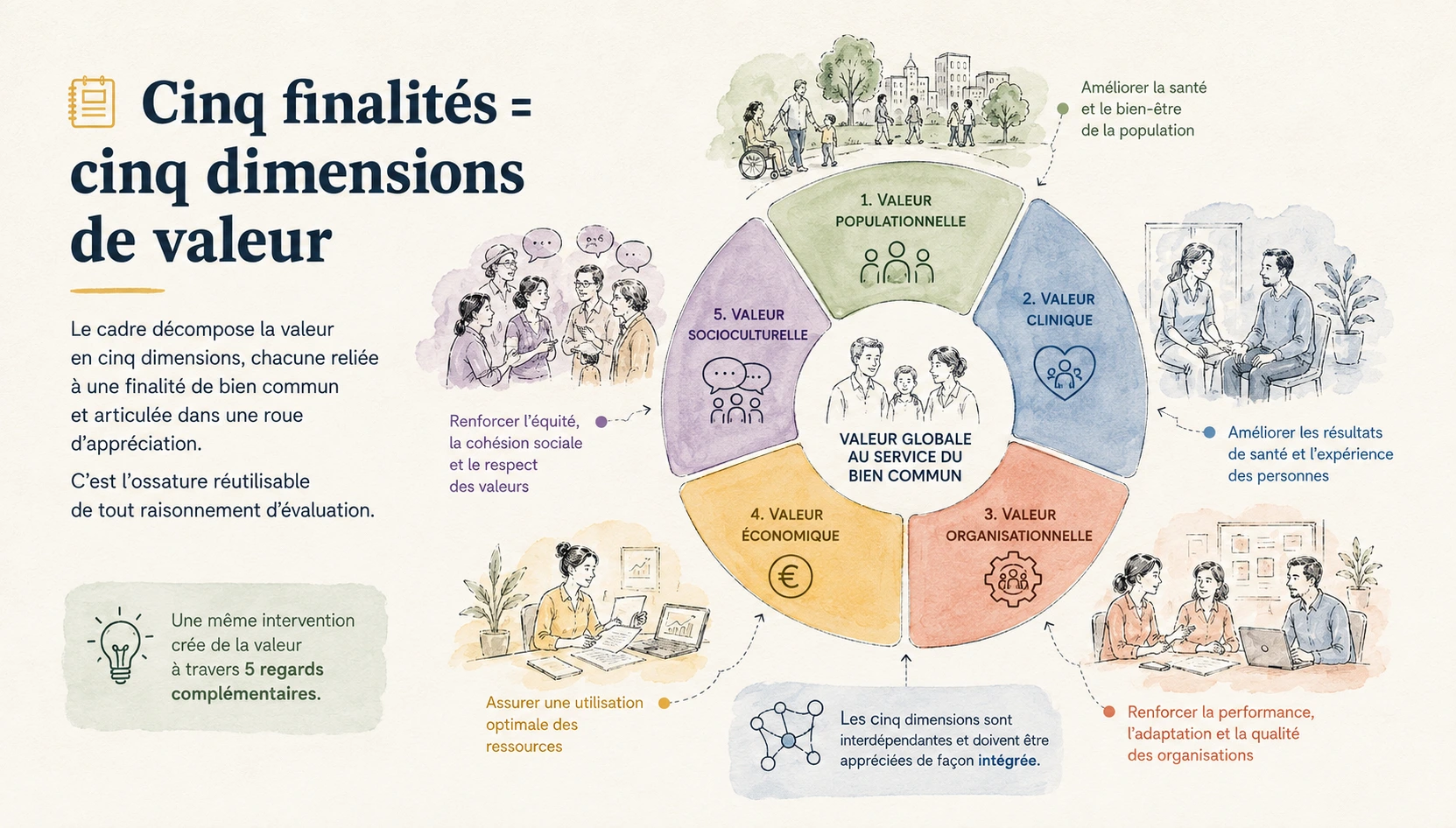
1️⃣ Five purposes = five dimensions of value. The framework breaks down value into population, clinical, organisational, economic, and sociocultural dimensions, each linked to a common good purpose and articulated in an appreciation wheel (p. 2). It is the reusable backbone of any evaluation reasoning.
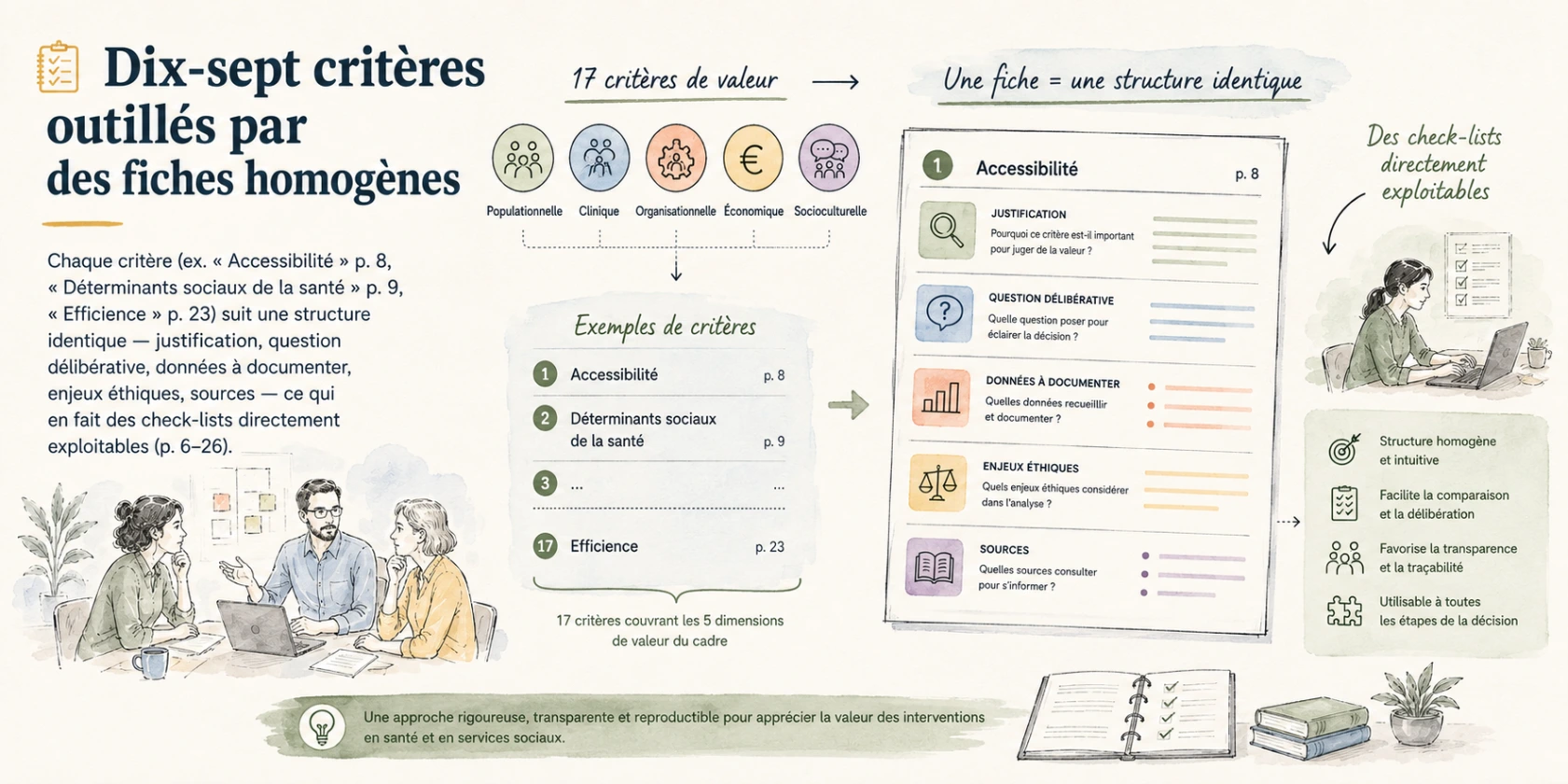
2️⃣ Seventeen criteria equipped with uniform sheets. Each criterion (e.g. “Accessibility” p. 8, “Social determinants of health” p. 9, “Efficiency” p. 23) follows an identical structure — justification, deliberative question, data to document, ethical issues, sources — making them directly usable check-lists (p. 6-26).
3️⃣ Methodological distinction evaluation / deliberation / uncertainty. The document rigorously separates the mobilisation of knowledge (evaluation questions) from value judgment (deliberation questions) and imposes the systematic identification of uncertainties by criterion (p. 4). It is a safeguard against decisions that confuse “data” and “choices.”
4️⃣ Anchoring on social determinants and vulnerable groups. The population dimension explicitly integrates the differential burden, unmet needs, and social determinants as levers for reducing inequalities (p. 5, 9), with a reminder of the characteristics of vulnerability (ethnicity, socioeconomic status, gender, disability, region) (p. 9).
5️⃣ Principle of subsidiarity and regional equity. The organisational dimension states that the intervention should be carried out "in the right place, at the right time, with the appropriate expertise", by competent but not overqualified individuals, while noting that the capacity for implementation varies from one territory to another and can affect regional equity (p. 15).
3️⃣ ACTION TRACKS FOR LOCAL ACTORS
1️⃣ Use the wheel of 5 dimensions (p. 2) as a framing template for any local evaluation or prioritisation project, before delving into the details of the criteria. Transposition France: review this framing in light of the CLS, CPTS, ARS levers and the HAS reference frameworks.
2️⃣ Adopt the criteria sheets as deliberation check-lists (p. 6-26): for each decision, tick the relevant criteria, document the available data, and then explicitly name the tensions between dimensions. The framework allows for partial mobilisation according to the "proportionality of efforts" (p. 4).
3️⃣ Systematise the declaration of uncertainties by criterion (p. 4) in decision reports: indicate what is known, what is uncertain, and the potential impact of this uncertainty — a practice directly transferable to a territorial steering committee.
4️⃣ Mobilise the sheet "Social Determinants" (p. 9) and "Accessibility" (p. 8) to objectify the impact of an action on vulnerable populations and identify access barriers (linguistic, health and digital literacy, geographical).
5️⃣ Apply the principle of subsidiarity (p. 15) to question the appropriate level of implementation of an intervention and anticipate capacity gaps between establishments or territories — useful for implantation decisions.
6️⃣ Address an unmet need: adaptation to the field audience. The framework is aimed at the scientific staff of INESSS and remains abstract; for associative or community use, provide a simplified version (FALC grid + concrete examples) and an explicit transposition to the French legal framework (Law of 2002-2, medico-social evaluation, HAS references).
4️⃣ ADDITIONAL REFERENCES
🔍➕ For more information, see the articles referenced by "Health Practices" file on participation ➡️🔗https://www.pratiquesensante.com/participation
1️⃣ High Authority of Health — European Regulation (EU) 2021/2282 on the evaluation of health technologies. Methodological supplement on the clinical dimension : the regulation applies from 12 January 2025 and deploys joint clinical assessments (JCA) at the European level, harmonising clinical evidence. Verified URL (active): https://www.has-sante.fr/jcms/p_3543049/fr/regarder-le-replay-evaluation-des-technologies-de-sante-en-france-impact-du-reglement-europeen Strategiesante
2️⃣ OECD — Health Outlook 2025: OECD Indicators (13 November 2025). Empirical supplement to the dimensions population, economic and organisational : the dashboards compare countries according to five dimensions (health status, risk factors, access, quality, capacities and resources), supplemented by the cross-cutting dimensions of efficiency, equity, sustainability and resilience. Verified URL (active) : https://www.oecd.org/fr/publications/panorama-de-la-sante-2025_2f564c6c-fr.html
3️⃣ OECD — Do health systems deliver on their promises? Results of the PaRIS survey (2025). Complement to the clinical dimension — experience and perceived health : the PaRIS survey focuses on indicators reported by patients in primary care (outcomes and care pathways). Verified URL (stable DOI) : https://doi.org/10.1787/81af0784-fr Alcimed
5️⃣ FREQUENTLY ASKED QUESTIONS (FAQ)
1️⃣ Who is this framework aimed at? For the scientific staff of INESSS, to guide all its evaluation work (p. 1). Field actors can use it as a reasoning framework, with adaptation.
2️⃣ What are the five dimensions of value? Population, clinical, organisational, economic and sociocultural (p. 2). They constitute the core of the framework.
3️⃣ Should an intervention be evaluated against all criteria? No. The framework specifies that an intervention cannot create value according to all criteria, and it may even reduce it; deliberation serves precisely to arbitrate these tensions (p. 3). Mobilisation can be partial according to the proportionality of efforts (p. 4).
4️⃣ Where are equity and vulnerable populations addressed? Mainly in the population dimension: "Extent of unmet need" (p. 7), "Accessibility" (p. 8) and "Social determinants of health" (p. 9).
5️⃣ How does the framework address efficiency? Efficiency relates mobilised resources to results; it is a "particular" criterion used to clarify trade-offs between dimensions (p. 3, 19, 23). Cost-utility analysis is the preferred method (p. 23).
6️⃣ Is the well-being of professionals taken into account? Yes, through the criterion "Experience and well-being of human resources" (safety, moral harm, satisfaction, professional autonomy) (p. 18).
7️⃣ What place for ethics and the environment? These are cross-cutting elements addressed in each dimension, with the possibility of a dedicated section if the ethical analysis is in-depth (p. 3-4); environmental considerations are illustrated dimension by dimension in the appendix (p. 27).
6️⃣ REWRITING IN FALC (Easy To Read and Understand)
What is this document?
INESSS is an organisation in Quebec. It helps to choose the right care and services. This document explains how to judge if an action has value. Judging value means asking whether an action is useful and for whom.
The 5 ways to judge value:
- For the population: does the action help many people? Does it help vulnerable people?
- For the person receiving care: does the action provide good care? Is it safe?
- For the system: Is the action easy to implement? Does it help the staff?
- For public money: Is the action fairly priced?
- For society: Does the action respect everyone's values?
Important ideas:
- Each action is judged with simple and clear questions.
- An action cannot be good in all respects. That's normal.
- We must say what we know and what we do not know.
- We pay attention to vulnerable people.
- We carry out the action in the right place, by the right people.
7️⃣ CROSS-ANALYSIS — VALUES OF HEALTH PRACTICES
Literacy: The criterion "Accessibility" explicitly includes the level of literacy (in health and digital) as an access barrier to address (p. 8); the document itself remains expert and not simplified.
Empowerment: User participation in the development of interventions is an element to document (p. 25-26), but the framework does not detail a method of involvement.
Participation: Stakeholder consultation is cited as a source in almost all criteria (p. 6-26); co-construction is mentioned without a formalized procedure.
Community health: The population dimension has a collective and equity aim (p. 5), but the territorial/community anchoring remains implicit.
Ethics: The biases and value tensions are addressed transversally, with examples of ethical issues by criterion (p. 3-4, 6-26) — this is a strong point of the document.
Human rights : The principles of equity, solidarity, autonomy, and inclusion explicitly structure the objectives (p. 2, 24).
Intersectorality : The sociocultural dimension and the criterion "Costs to society" open up to other sectors (education, housing, justice, environment) (p. 22, 25).
Partnership : The modalities of collaboration are among the organisational impacts to be documented (p. 17), without a formalised model.
Combating discrimination : The risk of stigma and discrimination is mentioned several times as an ethical issue (p. 6, 9, 25); non-stigmatisation and respect for diversity are taken into account.
8️⃣ EVALUATION OF THE RELIABILITY OF THE RESOURCE
Scientific relevance — high. Institutional document based on recognised literature (triple/quadruple/quintuple aim, accountability for reasonableness by Daniels, multi-criteria decision analysis by Goetghebeur, responsible innovation by Silva & Lehoux; p. 28) and recent internal productions. Genre to recall : normative doctrine, not empirical research — the statements are reasoned choices, not tested results.
9️⃣ STRATEGIC HASHTAGS
#ValueAppreciation #HealthEvaluation #SocialDeterminants #HealthEthics #HealthLiteracy #SharedDecision #INESSS #healthpractices
This article was developed in accordance with the Charter
of the use of artificial intelligence of Health Practices.
Click on the image