🚨 Evaluate a source in 5 questions: the method that fits in one session
🔍💡 Media education: ready-to-use sequences (cycle 2 → high school) to equip critical thinking in the face of misinformation, deepfakes, and AI. 56 pages of reusable sheets, from image decryption to media creation.
📌 Media and information literacy is not just a school subject: it is a cross-cutting protective skill, directly linked to critical thinking in the face of misinformation, including in health. This document offers ready-to-use, tested sequences, adaptable from cycle 2 to high school, with objectives, duration, materials, and step-by-step guidance. Everyone can draw reusable templates for a workshop — evaluate a source, decrypt an image, understand where a fake news item comes from — without starting from scratch. The concrete advantage: moving from a general discourse on “critical thinking” to specific activities that can be facilitated as soon as tomorrow.
Source :
📒 The essentials — Media and Information Education — School I College I High School (internally designated as “The Essentials of EMI”
✍️ CLEMI (Centre for Media and Information Education), service associated with the Réseau Canopé, with the support of GMF
Publication Director: Marie-Caroline Missir. Director of CLEMI: Serge Barbet. Scientific and Educational Director: Isabelle Féroc Dumez.
📜🔗LINK to the source
1️⃣ ANALYTICAL SUMMARY
A structured response to informational disorders. The document starts from an observation: in a digitised and deregulated environment, knowing how to search for, verify, and publish information becomes a fundamental civic skill. It targets teachers in primary and secondary education, prioritising those entering the profession, but explicitly opens up to a broader educational community (educators, social workers, library and media centre staff) and families (p. 4). The issues addressed are wide-ranging: distinguishing information, rumour, and opinion; misinformation and disinformation; conspiracy theories; deepfakes; freedom of expression and its limits; media economics and concentration; the emergence of generative AI in information production.
An operational resource, not a theoretical essay. The contribution lies in its format: educational sheets classified by theme, cycle, and skill, written by trainers from CLEMI and professionals, each with objectives, programme entries, duration, materials, and session outlines. There are also 'Info' sheets on key topics (economics of disinformation, AI) and guide sheets for publishing (creating a school media outlet, college media memo, right to image). Each sequence links to downloadable digital resources on clemi.fr. The overarching pedagogical thread is active and project-based pedagogy: one learns about information by producing it oneself.
2️⃣ KEY POINTS OF THE DOCUMENT
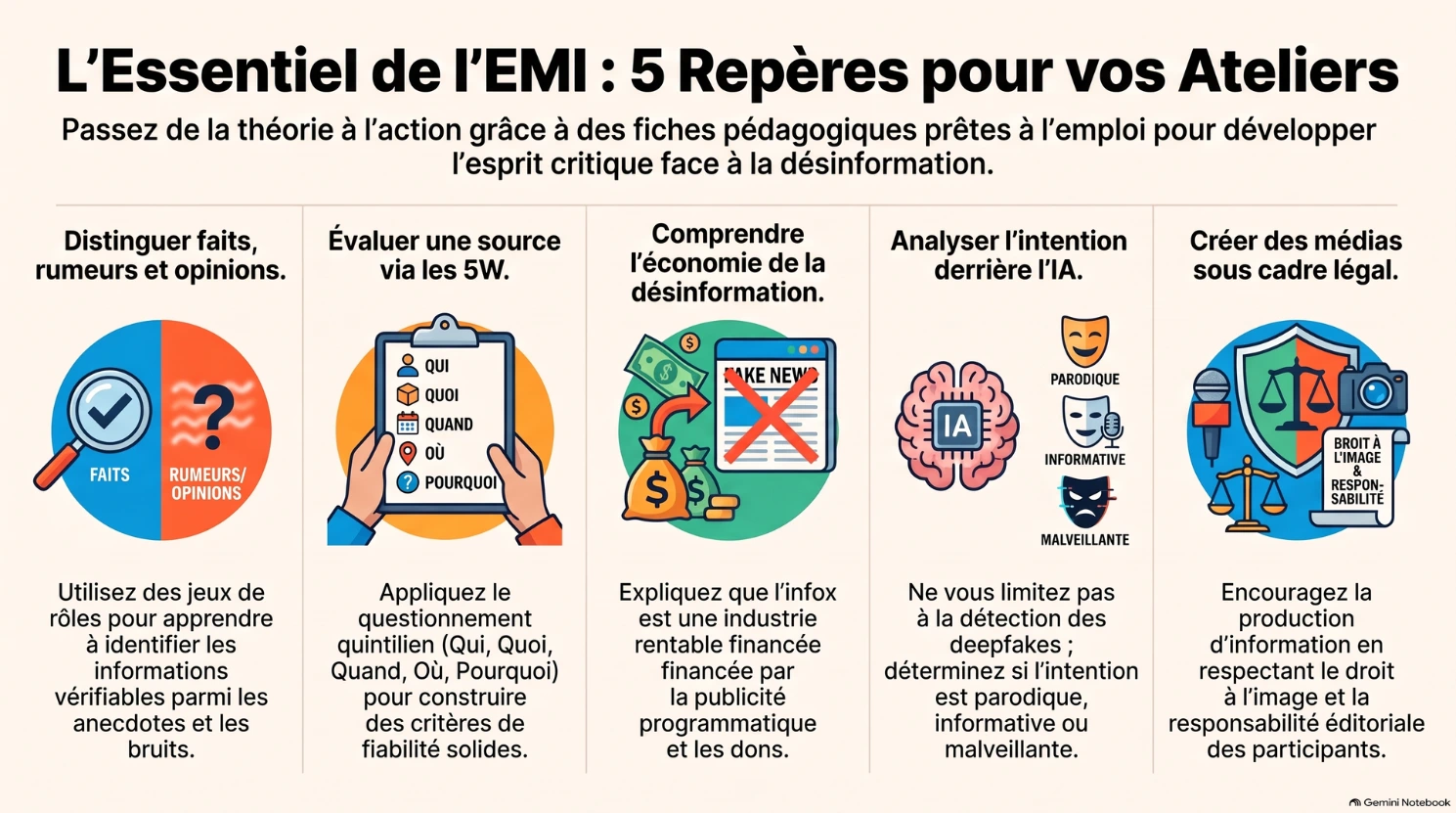
1️⃣ A progression from the concrete to the abstract, starting from cycle 2. The sequence "What is information?" distinguishes fact, rumour, opinion, and anecdote, then introduces the notion of direct/indirect source and the cross-referencing of sources through a role-play of journalists (p. 6). Applicable from Year 1 to Year 6 by adapting the activities.
2️⃣ A method for evaluating information based on the Quintilian questioning (5W). Students themselves build a list of criteria for the reliability of a source, with the strong idea that "there is no ideal method" and that verification takes time (p. 18). Includes verification of the origin of images (reverse search, metadata, geolocation).
3️⃣ The economic model of disinformation, quantified and documented. The document shows that the misinformation industry is funded by programmatic advertising and donations: according to a cited Newsguard-Comscore report, ~2.6 billion dollars/year in advertising revenue; example of the film Hold up (raising €300,000 from over 10,000 people) (p. 23).
4️⃣ A "deepfakes" document focused on intention, not just detection. From a corpus of real videos (historical reconstruction, entertainment, scams, source protection), students classify intentions and understand that not all manipulated videos are malicious: it depends on the intention and context (p. 30, secondary school).
5️⃣ Generative AI treated as a new object of media education. The background document explains the "predictive" functioning (statistically probable response, not "true"), the unneutralised biases, the absence of sources, and presents the conscious and controlled use as a civic issue, in reference to the European AI Act (p. 15). An application sequence exists from cycle 2 (p. 16).
3️⃣ ACTION PATHS FOR LOCAL ACTORS
1️⃣ Adapt the sequence "Evaluating Information" (p. 18) for a public workshop. The 5W grid and the co-constructed reliability criteria work equally well with adults and with cycle 4/high school students; useful for any workshop on misinformation, including in health.
2️⃣ Reuse the role-playing game "journalists" (p. 6) as an activity on cross-referencing sources. Source envelopes, information to verify: a mechanism transferable to a prevention workshop on "how to know if health information is reliable".
3️⃣ Rely on the "economic model of misinformation" document (p. 23) to explain why misinformation circulates. Moving from "it's false" to "it's profitable" helps an audience understand the mechanisms rather than just memorising falsehoods.
4️⃣ Mobilise the deepfakes document (p. 30) to work on intention and context. The corpus of videos allows moving away from the "true/false" reflex and addressing AI manipulation in a nuanced way. Necessary adaptation : check that the supporting videos are still accessible online.
5️⃣ Use the sheets "create a school media" (p. 48) and "memo media for college students" (p. 49) for a participatory project. They cover organisation, roles, GDPR and editorial responsibility (publisher, student over 16 in high school).
6️⃣ Address image rights in advance via the sheet p. 50 before any photo/video project. Concrete points (article 9 of the Civil Code, written permissions, limited duration, social media vigilance). Unmet need / adaptation : the AI tools mentioned in the AI sheet (Google Bard, My AI…) age quickly — update to current tools.
4️⃣ ADDITIONAL REFERENCES
1️⃣ Health Practices — Learning with digital - https://www.pratiquesensante.com/apprendre-avec-apprendre-le-numerique
️⃣ Wired School (Quebec) — "Developing media literacy: an act of continuous professional emancipation" (September 2025). External, French-speaking: focused on self-diagnosis and the ongoing training of the facilitator/teacher themselves — angle absent from the brochure.
5️⃣ FREQUENTLY ASKED QUESTIONS (FAQ)
1️⃣ Who is this document really aimed at? Primarily for teachers in primary and secondary education, including newcomers to the profession, but also for a wider community: educators, social workers, library/media library staff, and families (p. 4).
2️⃣ How to help young students distinguish between information and a rumour? Through the sequence of cycle 2/3: viewing, classifying proposals (information/rumour/opinion/anecdote), then students producing their own examples (p. 6).
3️⃣ Is there a simple method to evaluate a source? Yes: the Quintilian questioning (who, what, when, where, how, why/intentions), with collaborative construction of criteria — knowing that no method is ideal and that verification takes time (p. 18).
4️⃣ How to approach generative AI without demonising it? By explaining its "predictive" logic (likely answer ≠ true), its biases and its lack of sources, then setting the use of "conscious, controlled and responsible" as the objective (p. 15).
5️⃣ Are deepfakes always malicious? No. The sheet shows varied uses (historical reconstruction, entertainment, source protection, but also scams): the analysis focuses on the intention and context of the sender (p. 30).
6️⃣ Who can be the publisher of a student media? In middle school, the responsibility defaults to the head of the establishment, who can delegate (teacher, librarian, voluntary CPE) in writing; in high school, a student over 16 can assume it (p. 48–49).
7️⃣ How to manage image rights during a media project? Legal basis: article 9 of the Civil Code; written, archived, time-limited authorisation, with increased vigilance for social networks (specified distribution accounts) — therefore evolving case law (p. 50).
6️⃣ REWRITING IN EASY TO READ LANGUAGE
What the document says
This document helps to understand information. It is made by CLEMI, a service of the National Education. It is aimed at teachers. It can also serve educators and facilitators.
Today, there is a lot of information. Some is true. Others are false. The document teaches how to tell the difference.
What the document contains
The document offers ready-made activities. Each activity explains:
- the aim,
- the time required,
- the materials,
- what to do, step by step.
There are activities for both young and old.
The important ideas
- A piece of information is a fact. It is verified. It is not a rumour.
- To verify information, we ask 6 questions: who? what? when? where? how? why?
- We need to look at where the information comes from. That is the source.
- False information makes money. That is why there is so much of it.
- A "deepfake" video is made with a computer (AI). It can deceive. But not always: it depends on the purpose.
- AI provides the most likely answer. It is not always the truth.
- Students can create their own newspaper or their own radio.
7️⃣ CROSS-ANALYSIS — VALUES OF HEALTH PRACTICES
- Literacy : yes — the sequences are graded by cycle (from primary to secondary school) and adaptable to levels, with supporting digital resources.
- Empowerment : marked — active pedagogy where students produce information (role-playing, media creation) rather than receiving it.
- Participation : present — co-construction of reliability criteria by students, elected writings in school media.
- Community health : partial — the collective dimension exists (class projects, school life, CVC/FSE) but the entry remains educational, not community-based in the health sense.
- Ethics : addressed — biases of generative AIs (sexist, discriminatory) named (p. 15), question of intentions at the heart of several sheets.
- Human rights : yes — references to freedom of expression (law of 1881, DDHC 1789) and to Article 13 of the International Convention on the Rights of the Child (p. 48).
- Intersectorality : yes — partnerships with press, media, associations, researchers, European framework De facto.
- Partnership : formalised — academic network of coordinators, competitions (Médiatiks, #ZeroCliché), GMF support.
- Fight against discrimination : yes — #ZeroCliché competition on gender equality; vigilance on discriminatory biases of AI. Non-judgment is evident in the reception of students' representations as a starting point.
8️⃣ EVALUATION OF THE RELIABILITY OF THE RESOURCE
- Scientific relevance : high. Reference institutional issuer (public operator), provided bibliography (p. 51: academic works — Cordier, Frau-Meigs, Jehel/Saemmer — and online resources). Minor reservation: some numerical data relies on dated sources (advertising report 2017) and some named AI tools age quickly.
- Operational relevance : very high. Sheets directly usable (objectives, duration, materials, procedure), downloadable resources, transposable outside strictly educational frameworks with adaptation.
9️⃣ STRATEGIC HASHTAGS
#MediaEducation #DigitalLiteracy #CriticalThinking #Disinformation #EMI #ActivePedagogy #DigitalCulture #healthpractices
You can support Health Practices: https://www.pratiquesensante.com/blog/annonces-28/pour-soutenir-pratiques-en-sante-3253
This article has been developed in accordance with the Charter
of the use of artificial intelligence of Health Practices.
Click on the image